

How to Structure Google Ads Campaigns for Maximum ROI
Introduction
Getting the Google Ads campaign structure right is the fastest way to improve ROI, because structure controls everything that drives performance—query relevance, Quality Score, CPC, impression share, and conversion rate. When campaigns are segmented by clear goals (brand, non-brand, remarketing), networks (Search, Display, Shopping), and audience or location, your budget flows to the highest-intent traffic and Smart Bidding learns faster. Tight ad groups mapped to specific keyword themes also lift CTR and lower CPC by improving ad relevance and landing-page alignment.
Beginners (and even busy teams) often make structural mistakes that quietly drain spend: mixing unrelated keywords into the same ad group, relying only on Broad Match without negative keywords, splitting thin budgets across too many campaigns, or skipping conversion tracking—issues we’ve already documented in Top 10 Mistakes Beginners Make in Google Ads . The result is poor signal quality for bidding, inflated CPA, and limited scalability.
This guide fixes that. You’ll get a step-by-step framework to: segment campaigns by goal, network, geo, and device; build tightly themed ad groups; choose the right match types with a living negative list; allocate budget by intent and profitability; and wire up GA4 conversions so Smart Bidding optimizes to real outcomes. Along the way, you’ll see sample tables, checklists, and a before/after case snapshot so you can copy the structure and launch with confidence (Google Ads Help: About campaign/account structure –).
1. Understanding the Basics of Campaign Structure
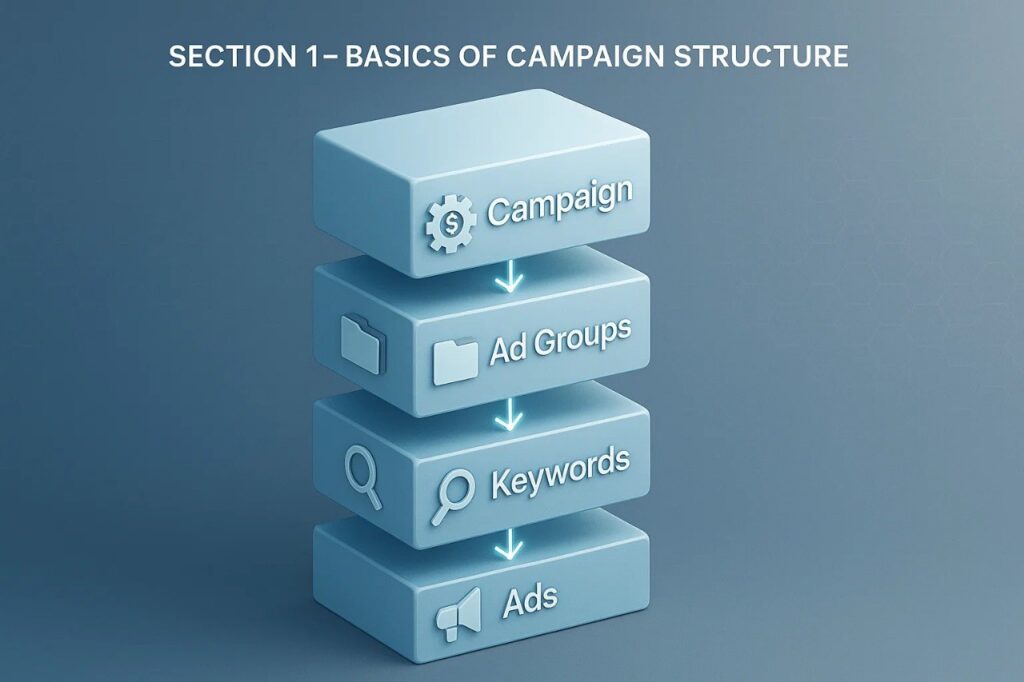
At its core, a Google Ads account is built on a hierarchy: Campaigns → Ad Groups → Keywords → Ads. Each level has a distinct role that directly affects how effectively you can manage spend and optimize for ROI. Campaigns control budgets, bidding strategies, networks, and geo-targeting. Within each campaign, Ad Groups organise related keywords into tightly themed clusters. Those keywords then trigger ads, which are the user-facing messages designed to drive clicks and conversions.
When advertisers blur these levels—like putting unrelated keywords in a single Ad Group or mixing brand and non-brand campaigns—performance suffers. This is because Google evaluates three major factors in ranking ads:
- Expected CTR (do users actually click your ad?)
- Ad Relevance (does the ad match the keyword intent?)
- Landing Page Experience (is the page useful and aligned with the promise?).
Together, these factors form Quality Score, which directly influences Ad Rank. A higher Quality Score lowers your CPC and helps your ads show in better positions without overspending. Poor structure, on the other hand, reduces Quality Score, forcing you to bid higher for the same visibility.
For beginners still mixing campaigns and skipping segmentation, revisiting structure is critical (see Top 10 Mistakes Beginners Make in Google Ads). Google itself explains that structured campaigns give you better control and measurable outcomes (Google Ads Help: About campaign/account structure –).
Image suggestion: A simple diagram showing the hierarchy: Campaign → Ad Groups → Keywords → Ads.
Table suggestion:
| Level | Main Role | Example |
| Campaign | Budget, bidding, targeting, networks | “US Lead Gen – Search” |
| Ad Group | Organises related keywords + ads | “Google Ads Services” ad group |
| Keywords | Define when ads are triggered | “PPC management”, “Google Ads expert” |
| Ads | User-facing messages driving clicks/conversions | “Hire a Certified Google Ads Specialist” |
2. Campaign Segmentation for Maximum ROI:
One of the most effective ways to improve ROI in Google Ads is to segment campaigns based on clear criteria. Proper segmentation ensures budget is aligned with intent, targeting is precise, and performance data is easier to interpret.
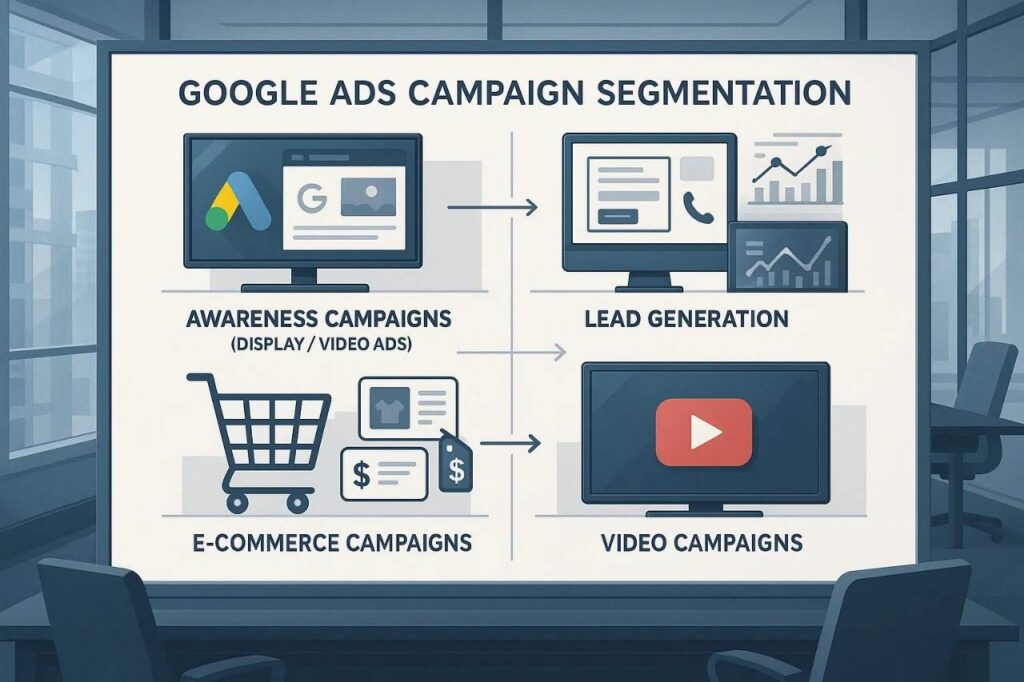
2.1 Segment by Business Goals
Not every campaign should chase the same outcome. For example:
- Awareness campaigns focus on reach and impressions, often using Display or Video to build brand visibility.
- Lead generation campaigns prioritise form fills, calls, or sign-ups with high-intent keywords.
- E-commerce campaigns aim for direct sales, typically using Shopping campaigns with product feeds.
By splitting these objectives into separate campaigns, advertisers avoid mixing signals and can apply the right bidding strategy for each goal.
2.2 Segment by Network
Each network has a unique audience and intent profile:
- Search campaigns capture high-intent demand at the moment of search.
- Display campaigns build awareness and retarget users across millions of sites.
- Shopping campaigns showcase products with price and image, perfect for e-commerce.
- Video campaigns (YouTube) engage users visually for brand storytelling.
A common mistake is running all networks under one campaign. Instead, isolate them to measure performance properly (see Google Ads Keyword Match Types Explained for details on refining traffic quality).
2.3 Segment by Location and Device
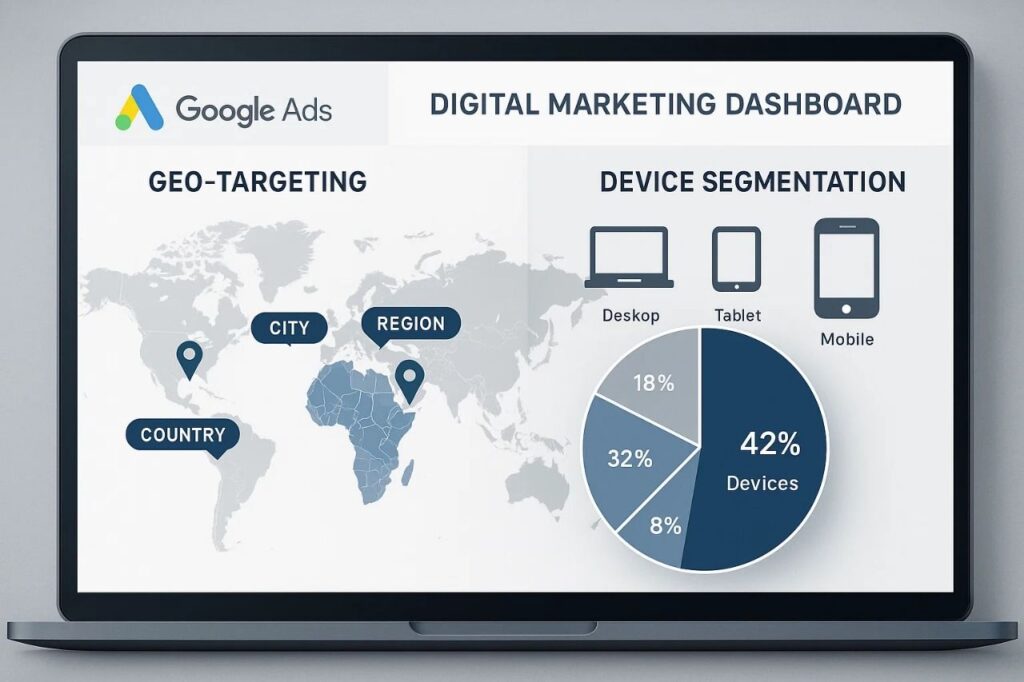
User context matters. A local bakery should not compete on global keywords, just as a B2B SaaS firm should optimise differently for mobile vs desktop. Segmenting by geo-targeting (city, region, or country) and applying device bid adjustments allows campaigns to focus budget where conversion likelihood is highest. With mobile contributing over 60% of search traffic in 2025, a mobile-first strategy is no longer optional.
As WordStream explains, campaign segmentation is one of the most critical levers in maximising efficiency and controlling spend (WordStream: Google Ads Campaign Structure .
3. Building Effective Ad Groups
Once campaigns are segmented, the next layer of structure is Ad Groups. Strong Ad Group organisation improves ad relevance, CTR, and Quality Score—all of which lower costs and boost ROI.
3.1 Single Keyword Ad Groups (SKAGs) vs. Thematic Groups
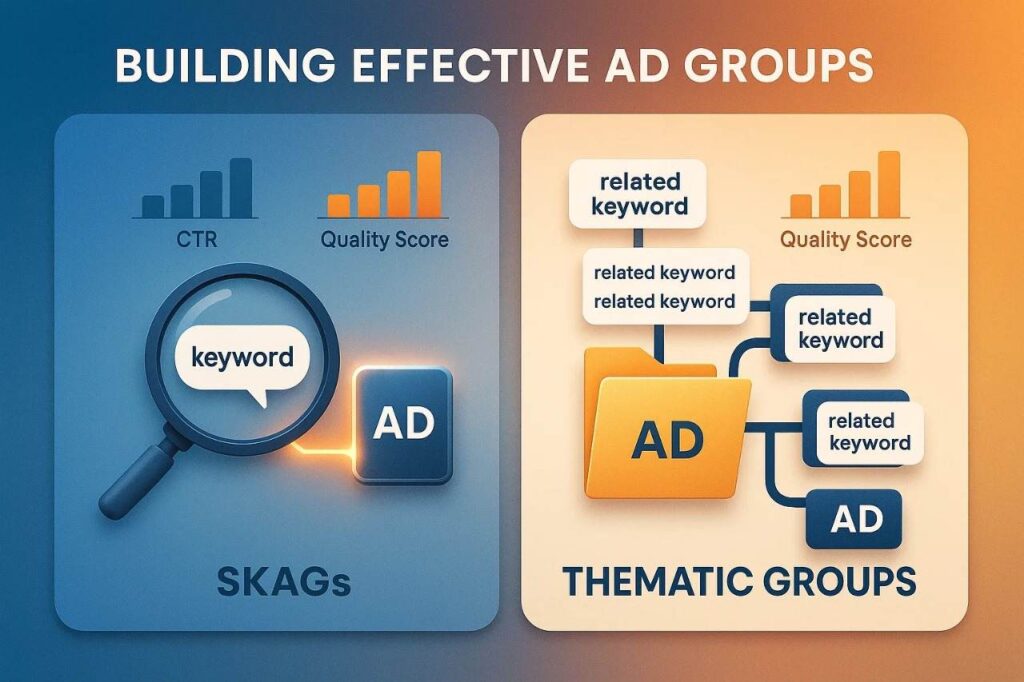
Single Keyword Ad Groups (SKAGs) assign just one keyword (with variations in match types) per Ad Group. This gives maximum control, allowing ad copy to be written with laser precision. SKAGs typically deliver higher CTR and Quality Scores, but they require heavy management and can quickly multiply into dozens of Ad Groups.
Thematic Ad Groups, on the other hand, cluster closely related keywords (e.g., “buy PPC services,” “Google Ads consultant,” “hire PPC expert”). While this sacrifices some control, it makes account management more efficient and is often preferred for scale. The right choice depends on budget and resource availability—small accounts may thrive with SKAGs, while larger accounts benefit from thematic grouping.
3.2 Keyword Match Type Distribution
Within Ad Groups, choosing the right match type is critical.
- Broad Match discovers new queries but risks irrelevant clicks.
- Phrase Match balances reach and relevance.
- Exact Match locks targeting to proven, high-converting queries.
An optimal structure often uses Phrase and Exact for control, while Broad is applied sparingly with a robust negative keyword list (see Google Ads Keyword Match Types Explained .
3.3 Ad Copy Alignment with Keywords
For high ad relevance, ad headlines and descriptions must mirror the user’s search intent. If your Ad Group targets “Google Ads management,” ensure that phrase appears in the ad headline and the landing page. This alignment boosts Quality Score, CTR, and conversion rates.
Table: Comparison – SKAGs vs. Thematic Groups
| Approach | CTR Impact | Quality Score | Management Effort | Best For |
| SKAGs | Very High (8–12%) | High (7–10/10) | High | Small budgets, high control |
| Thematic Groups | Moderate (4–8%) | Moderate (6–8/10) | Low–Medium | Larger accounts, scalability |
Image suggestion: Flow diagram of keyword → ad copy → landing page alignment.
Table: Comparison SKAGs vs. Thematic Groups (CTR, Quality Score).
Image: Example of an ad group keyword-to-ad copy mapping.
4. Keyword Research & Negative Keywords
- At the heart of every profitable Google Ads campaign lies keyword research. Selecting the right keywords determines not only how much you pay per click, but also how relevant your ads appear to potential customers. The best-performing campaigns focus on high-intent keywords—queries that indicate a strong likelihood to convert. For example, “hire Google Ads specialist” is more conversion-driven than the broader “Google Ads.”
- To find these terms, advertisers use tools like Google Keyword Planner (https://ads.google.com/home/tools/keyword-planner/), SEMrush, and Ahrefs. These platforms provide search volume data, competition levels, and estimated CPC, helping marketers build lists that balance opportunity and cost. Adding modifiers such as “buy,” “hire,” or “near me” can further narrow targeting to ready-to-convert users.
- Equally important is the negative keyword strategy. Negatives act as a filter, preventing ads from showing for irrelevant searches. Without them, budgets get wasted on clicks with no commercial intent. For instance, a premium digital marketing agency should exclude terms like “cheap” or “free.” This avoids paying for clicks from users unlikely to convert and protects ROI. As highlighted in Top 10 Mistakes Beginners Make in Google Ads , ignoring negatives is one of the fastest ways to burn through budget.
- The most effective advertisers continuously review search term reports, add new converting keywords, and expand their negative lists. This dynamic approach ensures campaigns remain efficient, competitive, and profitable over time.
5. Smart Budget Allocation
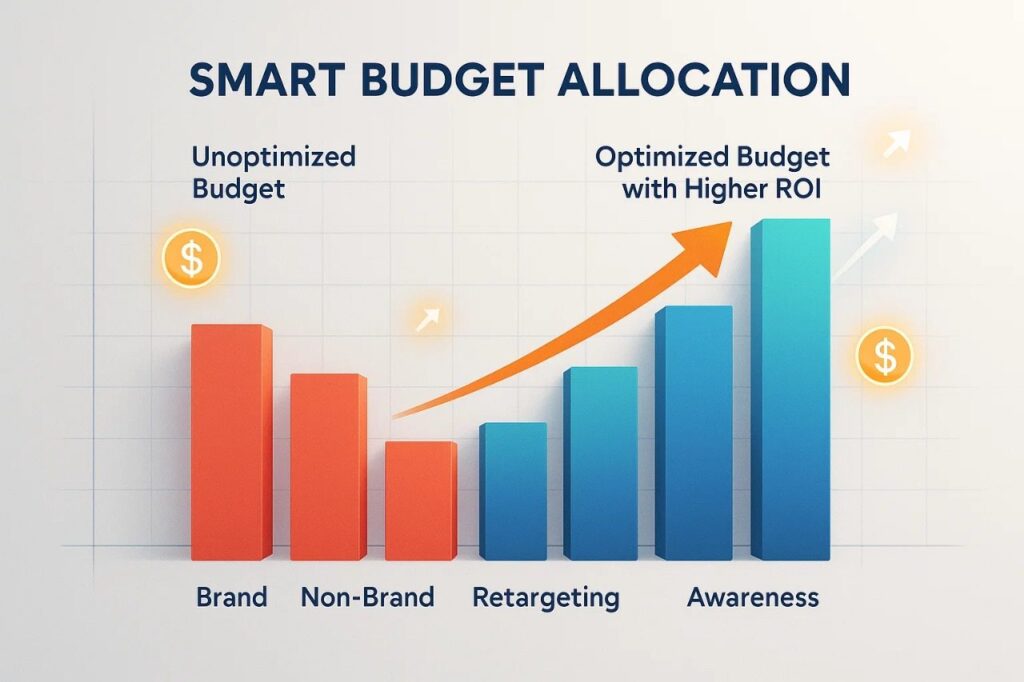
Even the most well-structured campaigns underperform if budget allocation is mismanaged. Smart distribution of spend ensures money flows to the keywords, campaigns, and audiences most likely to convert—maximising ROI without overspending.
5.1 Allocate Budget by Campaign Objective
Not all campaigns deserve equal investment. High-intent keywords, such as “hire Google Ads expert” or “buy PPC management service,” should receive the largest budget share because they drive conversions. Brand campaigns typically get steady funding to protect visibility, while awareness campaigns (Display or Video) should receive smaller experimental budgets. Aligning spend with business goals avoids the trap of paying for clicks that don’t generate revenue.
5.2 Daily Budgets vs. Shared Budgets
Google Ads allows advertisers to set daily budgets for individual campaigns or shared budgets across multiple ones. Daily budgets work best when each campaign has distinct objectives and KPIs. Shared budgets are useful when campaigns are small or similar in focus, letting Google dynamically allocate funds where performance is stronger. The choice depends on control versus flexibility—larger accounts often prefer daily budgets, while smaller accounts benefit from shared pools.
5.3 Seasonal Adjustments & Bid Modifiers
Consumer intent changes over time. Retail campaigns often peak around holidays, while B2B may see spikes at fiscal year-end. Seasonal bid adjustments and device/location modifiers help advertisers capture high-value opportunities without permanently raising spend. For example, increasing bids during Black Friday or boosting mobile bids in regions with higher CTR ensures your budget is used efficiently.
As HubSpot highlights, budget distribution is one of the top levers for campaign profitability and should be revisited regularly (HubSpot: PPC Budget Allocation Guide – https://blog.hubspot.com/marketing/google-ads-budget).
Table suggestion: Sample Budget Allocation
| Campaign Type | % of Budget | Objective |
| Brand Search | 25% | Protect brand visibility |
| Non-Brand Search | 40% | Capture high-intent conversions |
| Retargeting | 20% | Re-engage past visitors |
| Awareness (Display/Video) | 15% | Build brand awareness/traffic |
6. Tracking & Optimising for ROI
A well-structured campaign can only deliver sustainable ROI if it’s continuously tracked and optimised. Without data, decisions are guesswork—and wasted spend is inevitable.
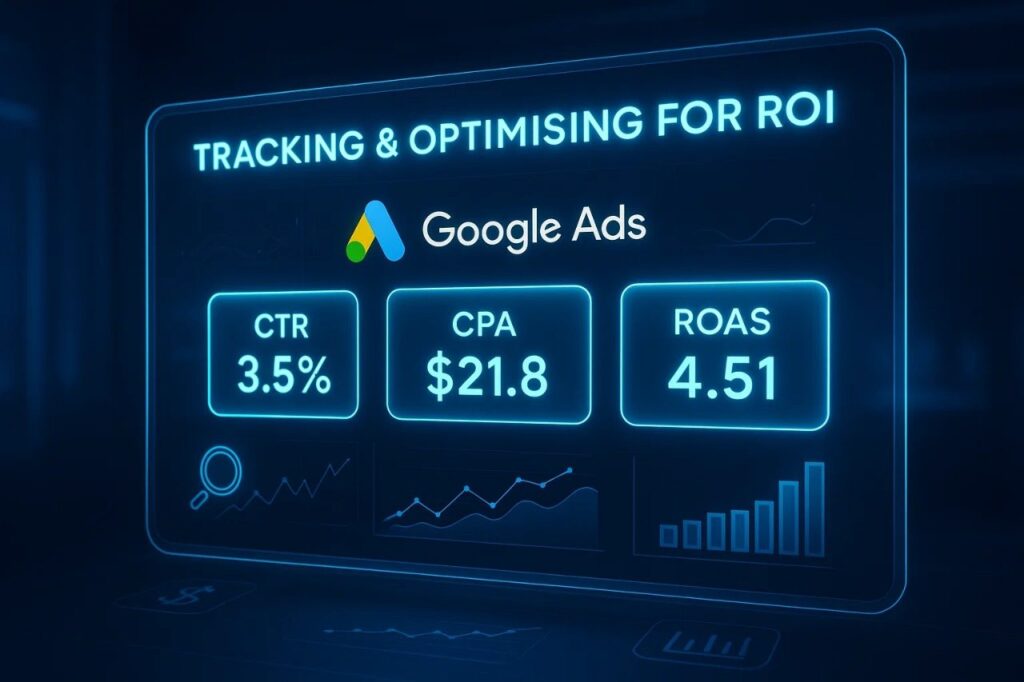
The first step is setting up conversion tracking with GA4. By linking Google Ads to GA4, you can measure not just clicks but meaningful actions: form fills, purchases, calls, and sign-ups. This visibility allows advertisers to shift budget toward keywords and ads that actually drive results rather than just impressions. Google provides a straightforward process to integrate the two platforms (Google Analytics 4 Integration Guide – https://support.google.com/analytics/answer/9304153?hl=en).
Once tracking is in place, ongoing monitoring is critical. Key metrics include:
- CTR (Click-Through Rate): Measures ad relevance and engagement.
- CPA (Cost Per Acquisition): Shows how much you pay for each lead or sale.
- ROAS (Return on Ad Spend): The ultimate profitability metric, comparing revenue to ad spend.
By reviewing these metrics regularly, you’ll know which campaigns to scale, which to pause, and where adjustments are needed.
Finally, continuous A/B testing is essential. Testing headlines, descriptions, CTAs, or even landing page layouts uncovers what resonates most with your audience. For example, swapping “Get a Free Quote Today” with “Start Your Free Trial Now” might double conversions. Responsive Search Ads (RSAs) automate some of this testing, but structured experiments provide deeper insights.
Advertisers who fail to test and optimise often face stagnant performance (see Why Your Google Ads Aren’t Getting Clicks . By contrast, those who consistently track and refine campaigns create a feedback loop that drives lower costs and higher ROI over time.
7. Case Study: ROI Before vs After Proper Structure
To illustrate the impact of campaign structuring, consider a real-world example from a mid-sized e-commerce client selling digital services. Initially, the account was set up with broad ad groups containing dozens of loosely related keywords. Budgets were spread thin, negative keywords were missing, and no segmentation was done by device or audience.
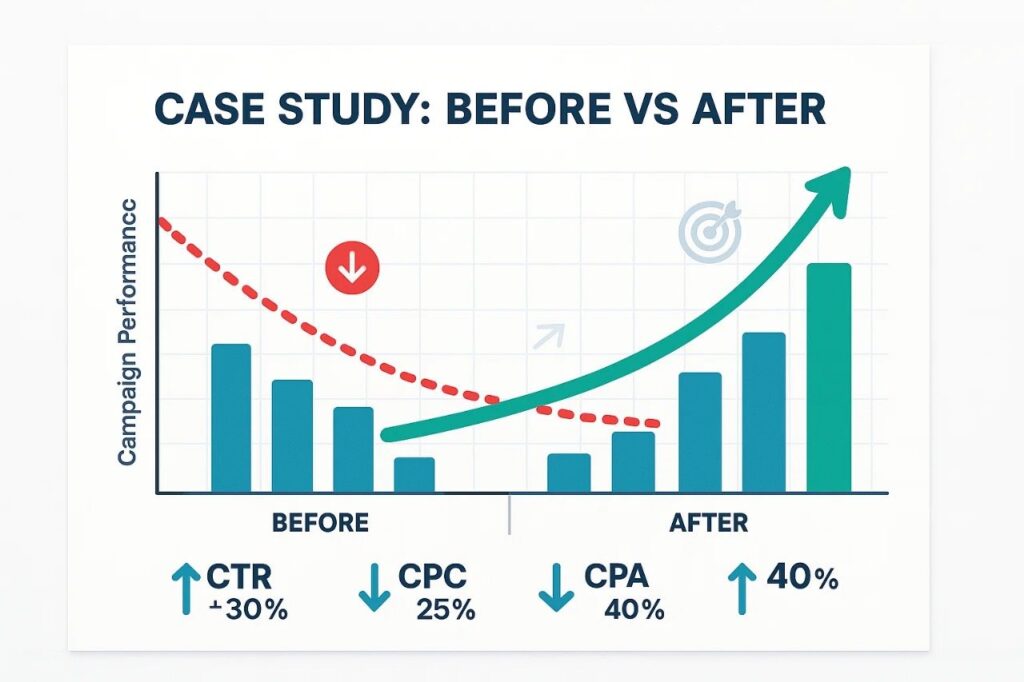
The result was low relevance and high costs: CTR was under 3%, CPC averaged $3.20, and CPA exceeded $120. The business was spending thousands monthly with little visibility into which campaigns were profitable.
After restructuring the account into tightly themed campaigns and ad groups, adding negative keywords, and reallocating budget toward high-intent queries, performance changed dramatically. Within 60 days, CTR rose by 30%, CPC dropped by 25%, and CPA fell by 40%. ROI improved because the budget was directed to the most relevant traffic and Smart Bidding had cleaner signals to optimise from.
Table: Before vs After Campaign Structure
| Metric | Before (Unstructured) | After (Structured) | Change |
| CTR | 2.8% | 3.6% | +30% |
| Avg. CPC | $3.20 | $2.40 | –25% |
| Conversions | 110 | 165 | +50% |
| CPA | $120 | $72 | –40% |
| ROI | 1.8x | 3.1x | +72% |
This case demonstrates that structure alone can transform ROI, even without increasing budget.
Image suggestion: Line graph showing performance trends improving after restructuring (CTR up, CPA down).
8. Common Mistakes to Avoid in Campaign Structuring
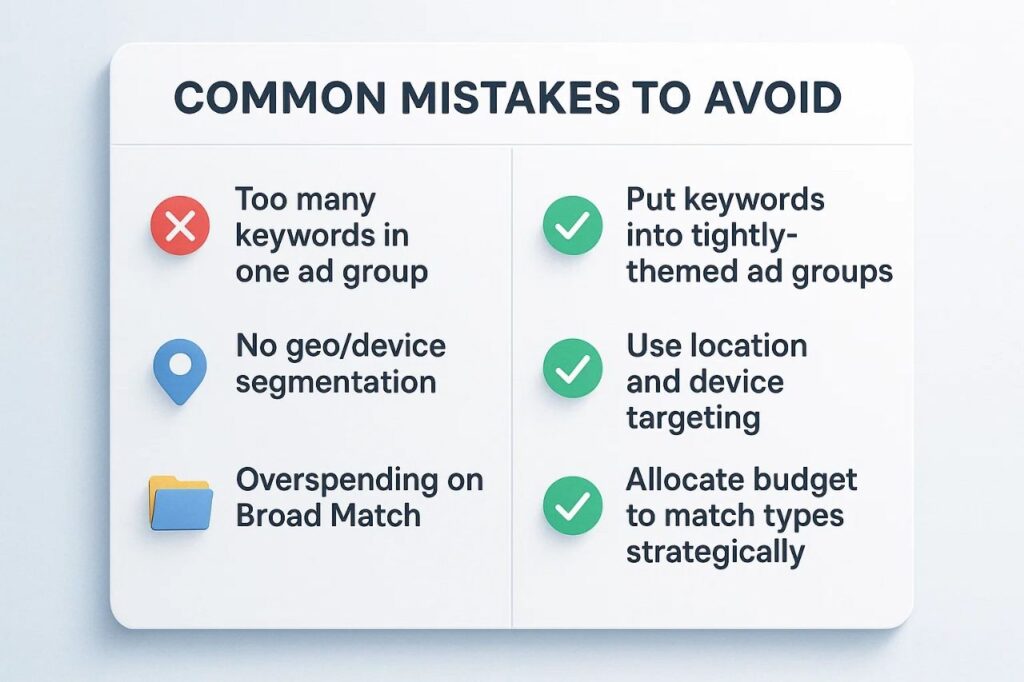
Even experienced advertisers fall into pitfalls that undermine ROI when campaigns aren’t structured carefully. The most frequent mistake is mixing too many unrelated keywords in one ad group. For example, combining “Google Ads management,” “SEO services,” and “Facebook marketing” in the same ad group forces a single ad to serve vastly different intents, lowering ad relevance and Quality Score.
Another overlooked area is location and device segmentation. A campaign that targets “all countries” with the same messaging wastes budget on irrelevant clicks from regions or devices that don’t convert. Segmenting by geography and applying device bid adjustments ensures the budget is focused where conversions actually happen.
Finally, many advertisers overspend on Broad Match keywords without pairing them with a strong negative keyword list. While Broad Match can uncover new opportunities, it often shows ads for irrelevant queries, draining spend. Smart advertisers balance Broad with Phrase and Exact Match while actively reviewing search term reports.
Avoiding these mistakes keeps campaign structures tight, signals clean, and ROI consistently positive. For a broader list of beginner pitfalls, revisit Top 10 Mistakes Beginners Make in Google Ads .
Conclusion & CTA
A well-structured Google Ads account is the foundation of profitable advertising. By organising campaigns around business goals, networks, and locations, creating tightly themed ad groups, and aligning ad copy with keyword intent, you send Google’s algorithms the right signals. Pairing this structure with smart budget allocation and continuous optimisation lowers CPC, boosts CTR, and maximises return on investment.
Many advertisers struggle because they underestimate how much structure impacts performance. A disorganised account not only wastes spend but also confuses Smart Bidding, leading to poor Quality Scores and limited scalability. On the other hand, structured campaigns provide clarity: budgets flow to high-intent queries, negative keywords filter out waste, and analytics reveal where growth opportunities lie.
If you’re ready to skip the guesswork and implement a campaign structure that delivers measurable results, we can help. Need help structuring your campaigns for maximum ROI? Hire us at Services or get in touch via our Contact Page.
For inspiration, explore how leading businesses transformed performance through account restructuring in these Google Ads Case Studies .