

Google Ads Keyword Match Types Explained (Broad, Phrase, Exact)
Introduction – Importance of Keyword Match Types
When running campaigns in Google Ads, your choice of keyword match types can make the difference between wasting budget and driving high-quality traffic. Match types control how closely a user’s search query must align with your chosen keywords for your ad to appear. In 2025, where competition and CPCs are higher than ever, understanding these match types is essential for optimising reach, relevance, and return on investment.
For beginners, match types serve as a gateway to controlling ad visibility. A business owner might want broad exposure to discover new keywords, while another may prefer precise targeting to maximise conversion rates. Without a clear strategy, ads risk showing irrelevant searches, leading to wasted spend and poor ROI.
At Google Ads Specialist, we help businesses navigate these challenges by tailoring keyword strategies to campaign goals. You can explore our Services , review Case Studies , or learn more from our Blog where we cover Google Ads best practices.
For a deeper understanding of how Google defines match types, check the official Google Ads Help Guide .
👉 Ready to make smarter keyword decisions? Start with a Google Ads Audit and see how your campaigns can perform better.
What Are Keyword Match Types?
Keyword match types in Google Ads determine how closely a user’s search must relate to your chosen keywords before your ad is triggered. Think of them as filters that control when your ads appear. By selecting the right match type, you decide whether to capture a wide audience or focus only on specific, high-intent searches.
There are three primary match types:
- Broad Match: Offers the widest reach, showing ads for related searches, synonyms, or variations.
- Phrase Match: Balances flexibility and control by showing ads when the meaning of the search aligns with your phrase.
- Exact Match: Provides the highest precision, triggering ads only when the query closely matches your keyword.
For advertisers in 2025, understanding these distinctions is critical. With rising CPCs and tighter competition, every click matters. Using the wrong match type could mean your ads show for irrelevant queries, burning through budgets without delivering qualified leads.
At Google Ads Specialist, we guide clients in choosing match types based on campaign goals—whether it’s brand awareness, lead generation, or sales. You can see how we apply these strategies in our Portfolio and explore practical insights on our Blog .
If you’re new to the platform, reviewing Services can help you understand how tailored campaign management ensures effective keyword use.
For a detailed breakdown, Google provides an official Keyword Match Type Guide .
3. Broad Match
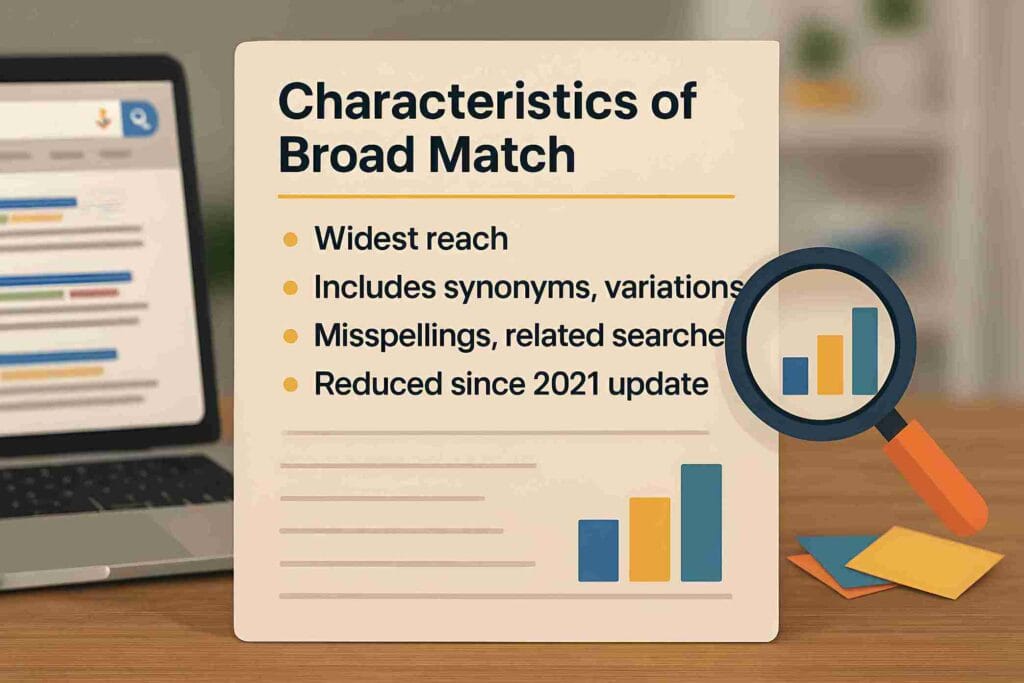
Broad Match is the default keyword setting in Google Ads and provides the widest reach among all match types. With this option, your ad can appear for searches that include synonyms, related terms, variations, and even user intent that Google’s AI interprets as relevant to your keyword.
How It Works
For example, if your chosen keyword is red shoes, your ad might also show for queries like buy scarlet sneakers, running shoes for men, or shoes for jogging. Google uses its algorithm to connect your keyword with related terms, expanding your visibility.
Advantages of Broad Match
- Wider audience reach: Helps uncover new keywords and markets.
- AI-driven intent matching: Google’s machine learning interprets the intent behind a query, not just exact words.
- Great for discovery: Useful when testing campaigns or launching new products.
Disadvantages of Broad Match
- Lower relevance: Ads may appear for loosely related or irrelevant queries.
- Budget inefficiency: Without negative keywords, you may pay for clicks that don’t convert.
- Requires constant monitoring: Search Term Reports must be reviewed regularly.
Best Practices in 2025
- Always use negative keywords to filter out irrelevant traffic.
- Combine Broad Match with Smart Bidding strategies like Target CPA or Target ROAS to let Google optimise for conversions.
- Start small—test broad match keywords with a limited budget before scaling.
- Monitor your Google Ads Dashboard frequently to ensure your clicks align with campaign goals.
- Consider pairing broad matches with phrases and exact matches for a hybrid strategy.
Broad Match can be powerful if managed carefully. At Google Ads Specialist, we use it strategically to maximise discovery while protecting ROI. Learn how we integrate keyword strategies into client campaigns on our Services page .
For further reading, see Google’s official Broad Match Overview .
4. Phrase Match
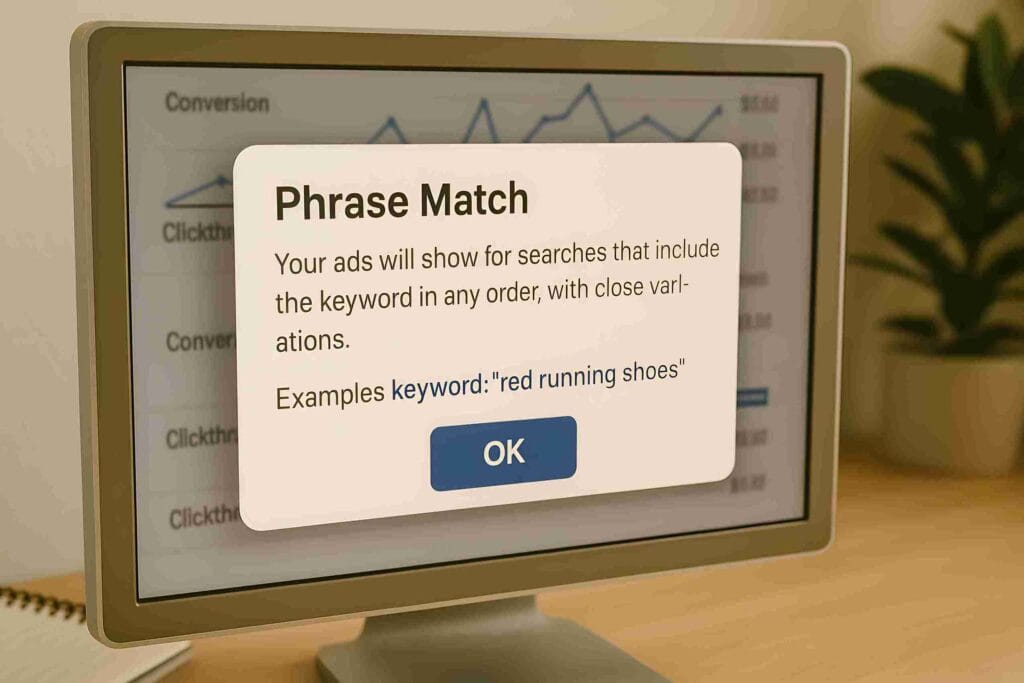
Phrase Match offers a balance between broad reach and tight control, making it one of the most popular keyword match types in Google Ads. With Phrase Match, your ad appears when a search query includes the meaning of your keyword phrase, even if additional words are added before or after.
How It Works
Suppose your keyword is affordable laptop. With Phrase Match, your ad might trigger for searches like best affordable laptop for students or affordable laptop deals online. Google’s algorithm interprets the intent of the phrase while still keeping your targeting focused.
Advantages of Phrase Match
- Balanced reach and control: Wider than exact match but narrower than broad match.
- Relevance: Ads show for queries that strongly align with the keyword’s meaning.
- Better ROI potential: Often leads to qualified traffic without overspending.
Disadvantages of Phrase Match
- Still needs monitoring: Some loosely relevant queries may sneak in.
- Moderate CPC: Can be more expensive than broad match in competitive niches.
- Dependent on intent accuracy: Google’s interpretation may not always match your goals.
Best Practices in 2025
- Use Phrase Match for mid-funnel targeting—great for users comparing products or services.
- Pair it with exact match keywords to capture both specific and intent-driven queries.
- Regularly review Search Term Reports to identify new opportunities or exclude irrelevant terms.
- Add negative keywords to refine targeting and protect your budget.
- Test Phrase Match in branded campaigns, where it captures variations of your brand name and services.
At Google Ads Specialist, we often recommend Phrase Match to advertisers who want to expand reach without losing focus. Learn more about how we structure campaigns on our Services page.
For deeper insights, visit Google’s Phrase Match Help Guide .
5. Exact Match
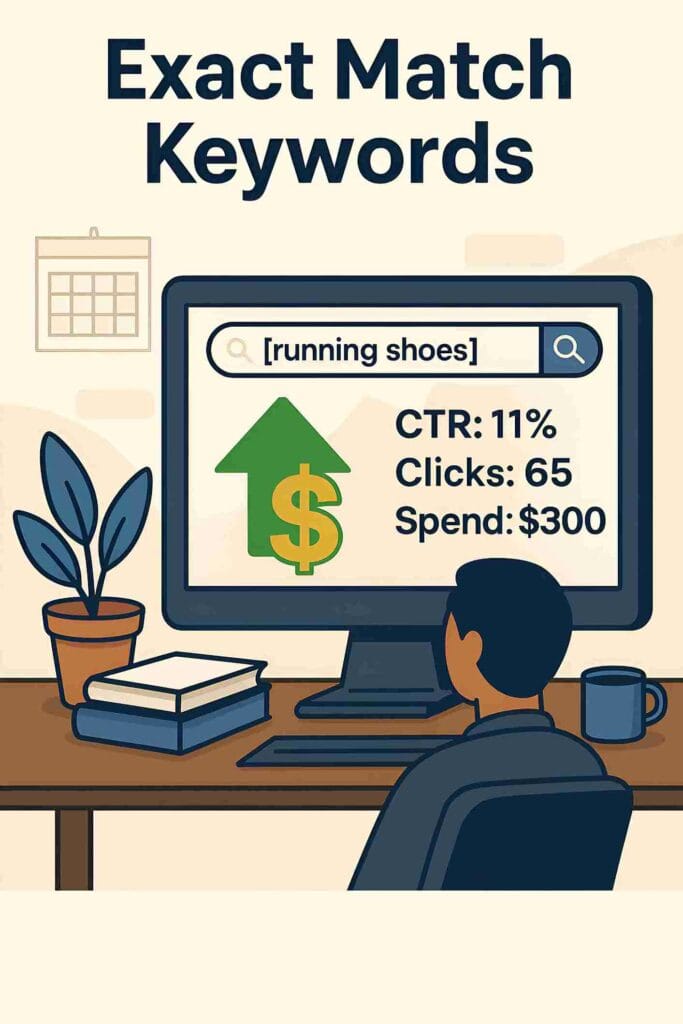
Exact Match is the most precise keyword match type in Google Ads, designed for advertisers who want maximum control over their campaigns. With Exact Match, your ad appears only when a user’s query has the same meaning or intent as your chosen keyword.
How It Works
For instance, if your keyword is buy iPhone 15 online, your ad could also show close variations such as purchase iPhone 15 online or iPhone 15 buy online. Unlike Broad or Phrase Match, Google restricts Exact Match to queries that closely match your keyword’s meaning.
Advantages of Exact Match
- High relevance: Ads show only to users with strong purchase or action intent.
- Better ROI: Fewer irrelevant clicks mean higher conversion potential.
- Budget efficiency: Ideal for advertisers who want every click to count.
Disadvantages of Exact Match
- Limited reach: You may miss out on broader search traffic.
- Higher CPC: Because of competition on exact terms, clicks can be expensive.
- Requires strong keyword research: Success depends on targeting the right terms.
Best Practices in 2025
- Use Exact Match for bottom-of-funnel campaigns where users are ready to buy.
- Combine with Phrase Match to capture mid-funnel intent while maintaining control.
- Focus on high-value keywords (e.g., product names, local services).
- Continuously monitor performance in your Google Ads Dashboard to refine keyword lists.
- Allocate higher budgets to Exact Match campaigns with proven ROI.
At Google Ads Specialist, we use Exact Match for clients aiming to maximise conversions and minimise wasted spend. Learn how we build profitable strategies on our Services page .
For Google’s official reference, see the Exact Match Overview .
6. Keyword Match Types Compared
Understanding the differences between Broad Match, Phrase Match, and Exact Match is key to building efficient Google Ads campaigns. Each match type serves a distinct purpose: Broad Match for reach, Phrase Match for balanced targeting, and Exact Match for precision. The right choice depends on your campaign goals, budget, and target audience.
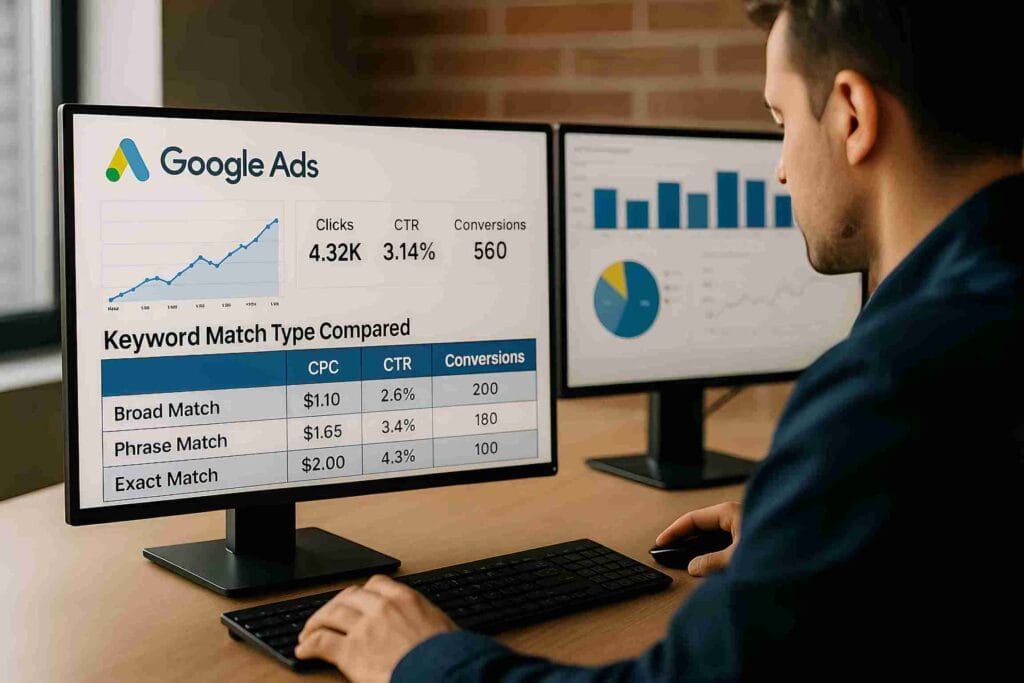
Below is a side-by-side comparison to help you decide which match type is best for your strategy:
Table 1: Keyword Match Types Compared
| Match Type | Example Keyword | Possible Triggered Searches | Control Level | Best For |
| Broad | red shoes | buy scarlet sneakers, jogging shoes | Low | Discovery, testing, new product launches |
| Phrase | affordable laptop | best affordable laptop for students | Medium | Mid-funnel, branded campaigns |
| Exact | buy iPhone 15 online | purchase iPhone 15 online | High | Conversions, high-intent targeting |
Key Takeaway
- Broad Match: Great for finding new opportunities but must be paired with negative keywords.
- Phrase Match: Best for campaigns that need both reach and relevance.
- Exact Match: Ideal when every click matters and ROI is the priority.
At Google Ads Specialist, we help businesses design hybrid strategies that use all three match types for maximum efficiency. Learn more in our Case Studies or explore our Services .
For further reading, see Google’s Match Type Comparison Guide .
7. Pros and Cons of Each Match Type:
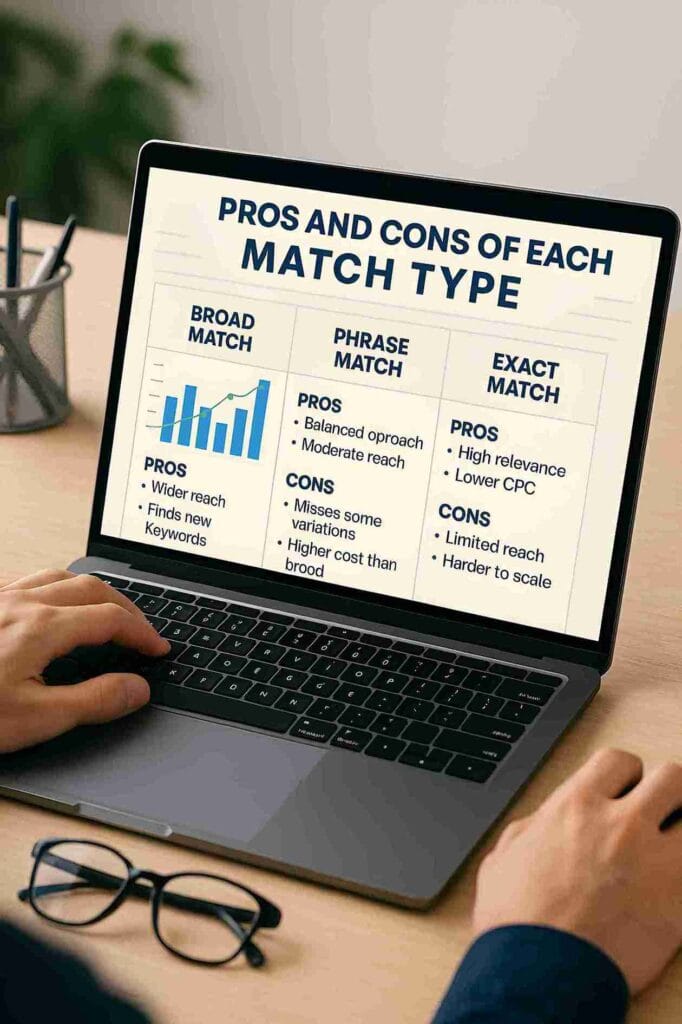
Every keyword match type in Google Ads comes with its own strengths and weaknesses. Choosing the right one is about balancing reach, control, and cost efficiency. While Broad Match maximises exposure, Phrase Match balances intent with flexibility, and Exact Match delivers the highest precision.
Table 2: Pros and Cons of Each Match Type
| Match Type | Pros | Cons |
| Broad | Wide reach, discovers new keywords, AI-driven intent | Risk of irrelevant clicks, wasted budget, needs negatives |
| Phrase | Balance of reach and control, higher relevance, good ROI | Some irrelevant queries, moderate CPC, ongoing monitoring needed |
| Exact | High precision, better ROI, minimal wasted clicks | Limited reach, higher CPC, requires solid keyword research |
Key Takeaway
- Use Broad Match for discovery but protect it with negative keywords.
- Apply Phrase Match when you want to balance cost and quality traffic.
- Deploy Exact Match for bottom-of-funnel campaigns where conversions matter most.
At Google Ads Specialist, we combine these match types into tailored strategies that match client goals. Check out our Portfolio to see how we apply them in real campaigns, or explore Services to start optimising your own ads.
8. Strategy Guide for 2025
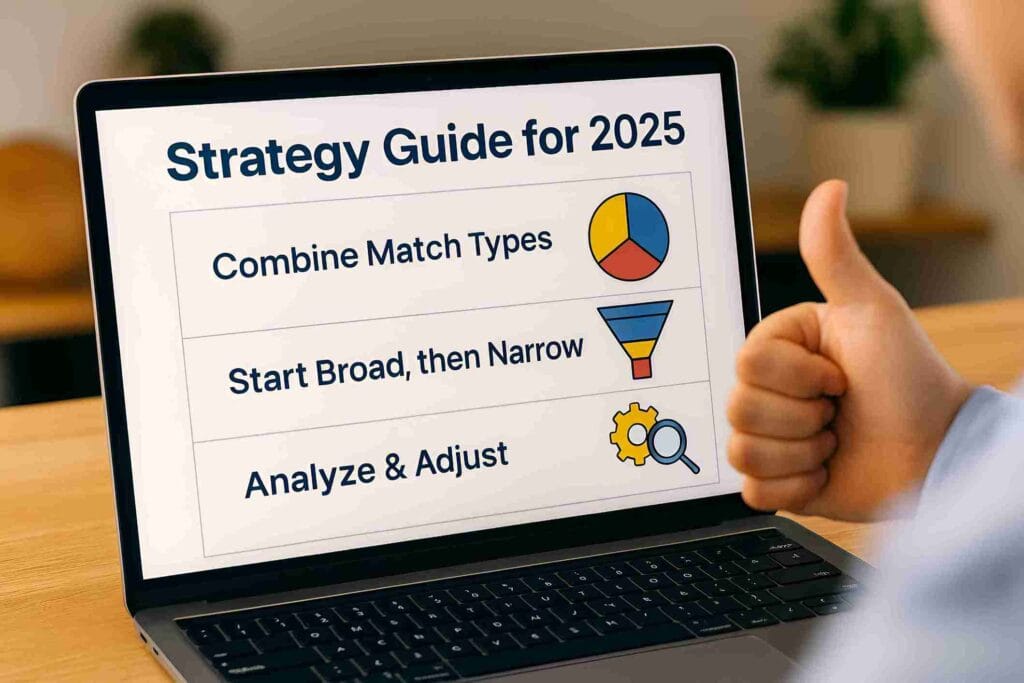
With rising CPCs and smarter algorithms, advertisers in 2025 must adopt a strategic approach when using keyword match types. Instead of relying on just one, the best campaigns combine Broad, Phrase, and Exact Match in a layered strategy that balances reach, cost, and ROI.
Table 3: Match Type Strategy in 2025
| Match Type | Recommended Use | Budget Impact | ROI Potential |
| Broad | Test new markets, discover keyword variations | Higher risk, requires tight monitoring | Medium (if paired with Smart Bidding + negatives) |
| Phrase | Mid-funnel targeting, branded terms, comparisons | Moderate spend, scalable | High (balanced reach + relevance) |
| Exact | High-intent keywords, product/service names, local searches | Higher CPC but efficient | Very High (drives qualified leads and sales) |
Strategic Insights
- Start small with Exact Match to build high-quality data from users most likely to convert.
- Layer Phrase Match to capture variations and expand audience reach while keeping relevance strong.
- Use Broad Match sparingly, only when paired with Smart Bidding (Target CPA/ROAS) and strict negative keywords.
- Allocate budgets based on performance: more towards Exact and Phrase, less towards Broad.
- Perform regular audits () to cut waste and optimize spend.
At Google Ads Specialist, we design hybrid strategies tailored to business goals. Whether you want conversions, awareness, or growth, our Services can help align keyword match types with measurable success.
9.Common Mistakes with Match Types
Even with the best intentions, advertisers often misuse keyword match types in Google Ads, leading to wasted spend and poor ROI. Recognising these mistakes early can save significant budget and improve campaign performance.
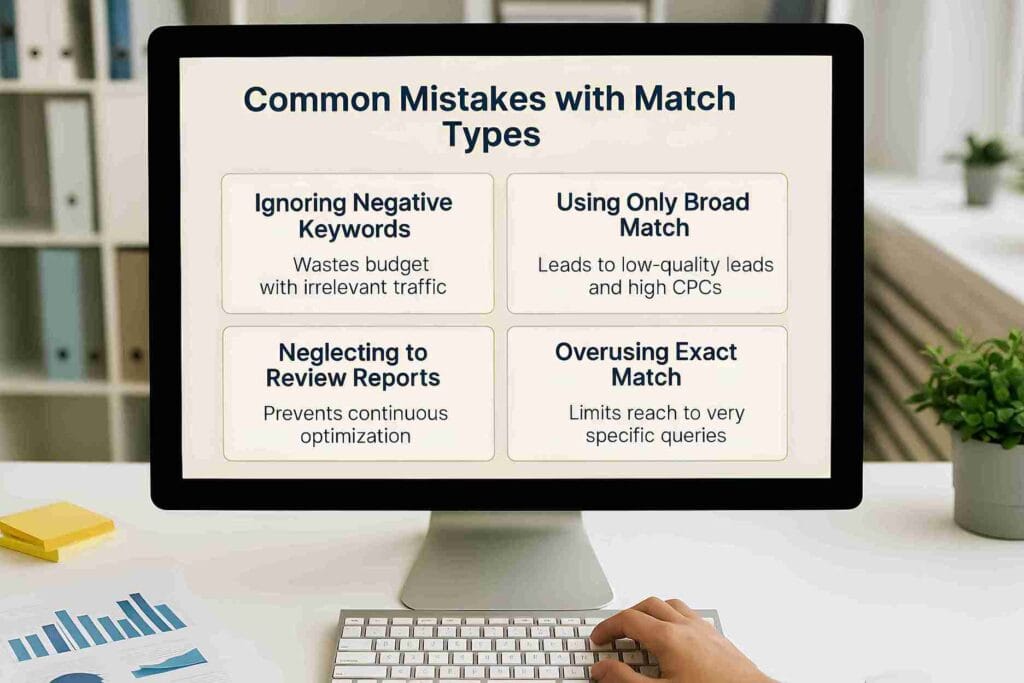
- Using Only Broad Match
Many beginners rely exclusively on Broad Match, thinking it guarantees visibility. While it does, it also opens the door to irrelevant clicks. Without negative keywords , budgets are drained quickly.
- Ignoring Search Term Reports
Advertisers often forget to review the Search Term Report . This leads to missed opportunities for new keywords or failure to block irrelevant queries. Regular analysis ensures your ads show for the right searches.
- Failing to Mix Match Types
Sticking to just one match type limits results. A strong campaign uses Exact Match for precision, Phrase Match for relevance, and Broad Match (with controls) for discovery.
- No Negative Keywords
Without negatives, irrelevant terms creep in across all match types. This mistake is common with Broad and Phrase Match campaigns.
- Not Testing Enough
Some advertisers assume Exact Match is always best. While it’s precise, relying solely on it can reduce reach. Testing multiple match types reveals what combination drives the best ROI.
At Google Ads Specialist, we regularly audit campaigns to identify these issues. Our Case Studies show how correcting simple match type mistakes has doubled ROI for clients.
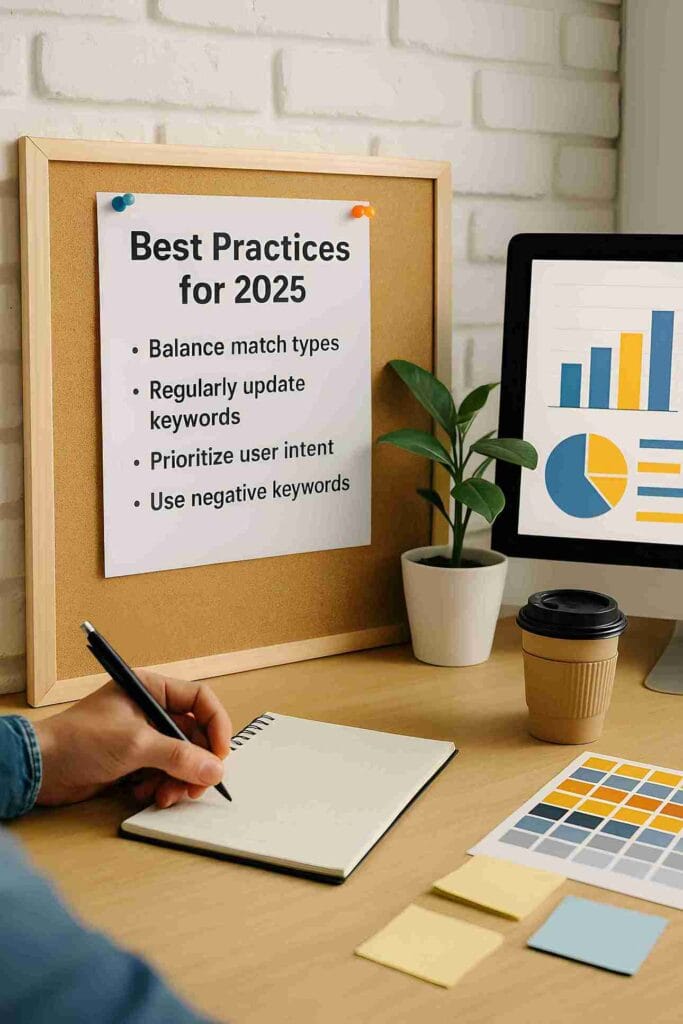
10. Best Practices for 2025
As Google Ads becomes more competitive in 2025, advertisers must apply smarter strategies to maximise efficiency with keyword match types. The goal is not just traffic, but qualified traffic that converts.
Key Best Practices
- Start with Exact Match
Focus on high-value, high-intent keywords to ensure every click has strong conversion potential. - Expand with Phrase Match
Once Exact Match data is collected, use Phrase Match to capture variations and mid-funnel users. - Use Broad Match with Smart Bidding
Broad Match can be powerful when paired with Target CPA or Target ROAS. Always combine it with negative keywords . - Audit Campaigns Regularly
Review Search Term Reports to cut waste and discover profitable new terms. - Leverage Automation
Google’s AI tools, like Smart Bidding and Dynamic Search Ads, optimize performance when layered with a solid match type strategy. - Test and Adjust
Run A/B tests on match type combinations. What works for one industry or business may differ for another.
At Google Ads Specialist, we apply these best practices across campaigns to ensure clients maximize ROI. Explore our Blog for more strategies or contact us for a Google Ads Audit .
12. Conclusion
– Choosing the right Google Ads keyword match type is one of the most important decisions you’ll make when building campaigns in 2025. Broad Match helps discover new opportunities, Phrase Match balances reach with relevance, and Exact Match drives high-intent conversions. When combined strategically, these match types can transform wasted clicks into profitable results.
However, success requires more than just knowing the definitions—it takes ongoing monitoring, smart bidding, negative keywords, and expert optimisation. Businesses that treat match types as part of a larger strategy consistently achieve higher ROI and more sustainable growth.
At Google Ads Specialist, we help clients unlock the full potential of their campaigns with customised match type strategies. Whether you’re starting fresh or looking to improve existing ads, we’re here to guide you.
👉 Hire a Google Ads Specialist Today and ensure every click counts toward your business success.
Q: What are Google Ads keyword match types?
Google Ads keyword match types control how closely a user’s search query must relate to your chosen keywords before your ad appears. They include Broad Match, Phrase Match, and Exact Match.
Q: Which match type is best for beginners?
For beginners, Exact Match is often the best starting point because it gives the highest control and reduces wasted spend. As campaigns mature, Phrase and Broad can be added strategically.
Q: Is Broad Match a waste of money?
Not necessarily. Broad Match can be powerful for discovering new keywords and markets—but it must be paired with negative keywords and Smart Bidding to avoid wasted clicks.
Google Ads keyword match types control how closely a user’s search query must relate to your chosen keywords before your ad appears. They include Broad Match, Phrase Match, and Exact Match.
For beginners, Exact Match is often the best starting point because it gives the highest control and reduces wasted spend. As campaigns mature, Phrase and Broad can be added strategically.
Not necessarily. Broad Match can be powerful for discovering new keywords and markets—but it must be paired with negative keywords and Smart Bidding to avoid wasted clicks.
Q: How do Phrase Match keywords work?
Phrase Match shows ads when the meaning of your keyword is included in the search query. For example, affordable laptop could trigger best affordable laptop for students.
Q:Why is Exact Match more expensive?
Exact Match often has a higher CPC because competition is intense for high-intent keywords. However, it usually delivers better ROI since clicks are highly relevant.
Q: Should I use all three match types?
Yes. A hybrid strategy works best:
Broad Match for discovery
Phrase Match for mid-funnel targeting
Exact Match for high-intent conversion
Q: Should I use all three match types?
Use negative keywords, monitor Search Term Reports, and regularly audit campaigns to ensure only qualified traffic is targeted.
Phrase Match shows ads when the meaning of your keyword is included in the search query. For example, affordable laptop could trigger best affordable laptop for students.
Exact Match often has a higher CPC because competition is intense for high-intent keywords. However, it usually delivers better ROI since clicks are highly relevant.
Yes. A hybrid strategy works best:
Broad Match for discovery
Phrase Match for mid-funnel targeting
Exact Match for high-intent conversion
Use negative keywords, monitor Search Term Reports, and regularly audit campaigns to ensure only qualified traffic is targeted.