

Google Ads vs. Facebook Ads: Which is Best for You?
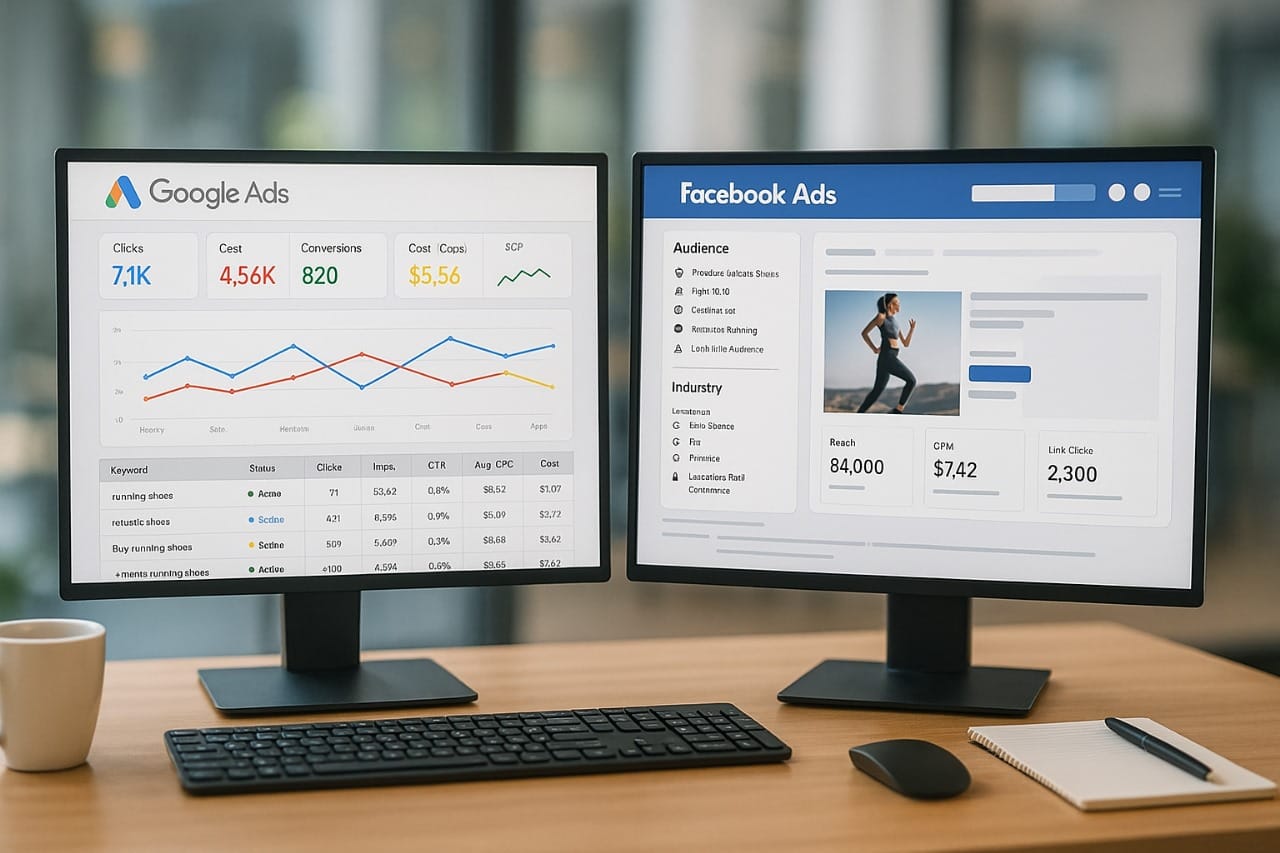
Introduction – Google Ads vs. Facebook Ads:
- In 2025, digital advertising continues to dominate business growth strategies, with companies of all sizes investing heavily in online platforms to attract and retain customers. With global competition and consumer behaviour shifting rapidly to digital-first channels, advertising online is no longer optional—it’s essential. Businesses that want measurable results, whether in sales, leads, or brand visibility, are increasingly turning to two major platforms: Google Ads and Facebook Ads.
- The comparison between these two advertising giants is a common debate among entrepreneurs and marketers. Google Ads connects businesses with high-intent customers actively searching for products or services, while Facebook Ads allows precise targeting of audiences based on their demographics, interests, and behaviours. Each platform has unique strengths, and choosing the right one depends on business goals, budget, and customer journey stage.
- This guide will provide a detailed look at both platforms—what they are, how they work, their costs, advantages, and drawbacks. We’ll also highlight which platform is best suited for different business types and whether a hybrid strategy is the smartest choice. By the end, you’ll have clarity on where to invest your advertising budget for maximum ROI.
To see how we deliver measurable results, explore our Case Studies.
2. What is Google Ads?
Google Ads is Google’s online advertising platform that allows businesses to promote their products and services across Google Search, YouTube, Gmail, Maps, and millions of partner websites. Unlike traditional advertising, where you pay for visibility, Google Ads primarily operates on a pay-per-click (PPC) model—meaning you only pay when someone clicks your ad.
The real strength of Google Ads lies in intent-driven marketing. When a user searches for “best running shoes” or “emergency plumber near me,” they’re already expressing a need. Google Ads ensures your business appears at the top of those search results, giving you immediate access to motivated, high-intent customers.
Key Benefits of Google Ads:
- Instant visibility: Your business can appear on page one within hours.
- Flexible budgets: Set daily or monthly spend caps to control costs.
- Measurable ROI: Track impressions, clicks, leads, and sales in real-time.
- Targeting precision: Narrow down by keywords, location, device, and demographics.
For beginners, Google Ads is particularly valuable because it delivers results quickly and provides clear performance data to refine campaigns. Whether you’re a local business looking for nearby customers or an e-commerce store aiming for global reach, Google Ads offers scalable solutions.
👉 Ready to harness Google Ads for your business? Explore our Google Ads Management service to see how we set up and optimise campaigns for maximum ROI.
3. What are Facebook Ads?
Facebook Ads, part of the Meta Business Suite, is a powerful advertising platform that allows businesses to reach highly targeted audiences across Facebook, Instagram, Messenger, and the Audience Network. Unlike Google Ads, which targets users based on search intent, Facebook Ads focus on audience-based targeting—showing ads to people based on their interests, demographics, behaviours, and online activity.
When you run a Facebook ad, it can appear in multiple placements: the Facebook newsfeed, Instagram stories, Messenger inbox, or even within partner apps. This makes it ideal for businesses that want to generate awareness, build communities, or promote visually engaging products.
Key Benefits of Facebook Ads:
- Advanced audience targeting: Create custom audiences, lookalike audiences, or retarget past visitors.
- Engagement-driven formats: Use video, carousel, or collection ads to tell brand stories.
- Cost-efficient reach: Typically lower cost-per-thousand impressions (CPM) compared to search ads.
- Cross-platform exposure: Advertise across Facebook and Instagram seamlessly.
For businesses, Facebook Ads are particularly effective when trying to build brand awareness, drive social engagement, or retarget audiences that have interacted with your brand before. It’s not just about direct conversions—it’s about building relationships with potential customers through compelling, creative ads.
👉 To learn directly from Meta, check out the official Meta Business Ads Guide.
4. Google Ads vs. Facebook Ads: Key Differences
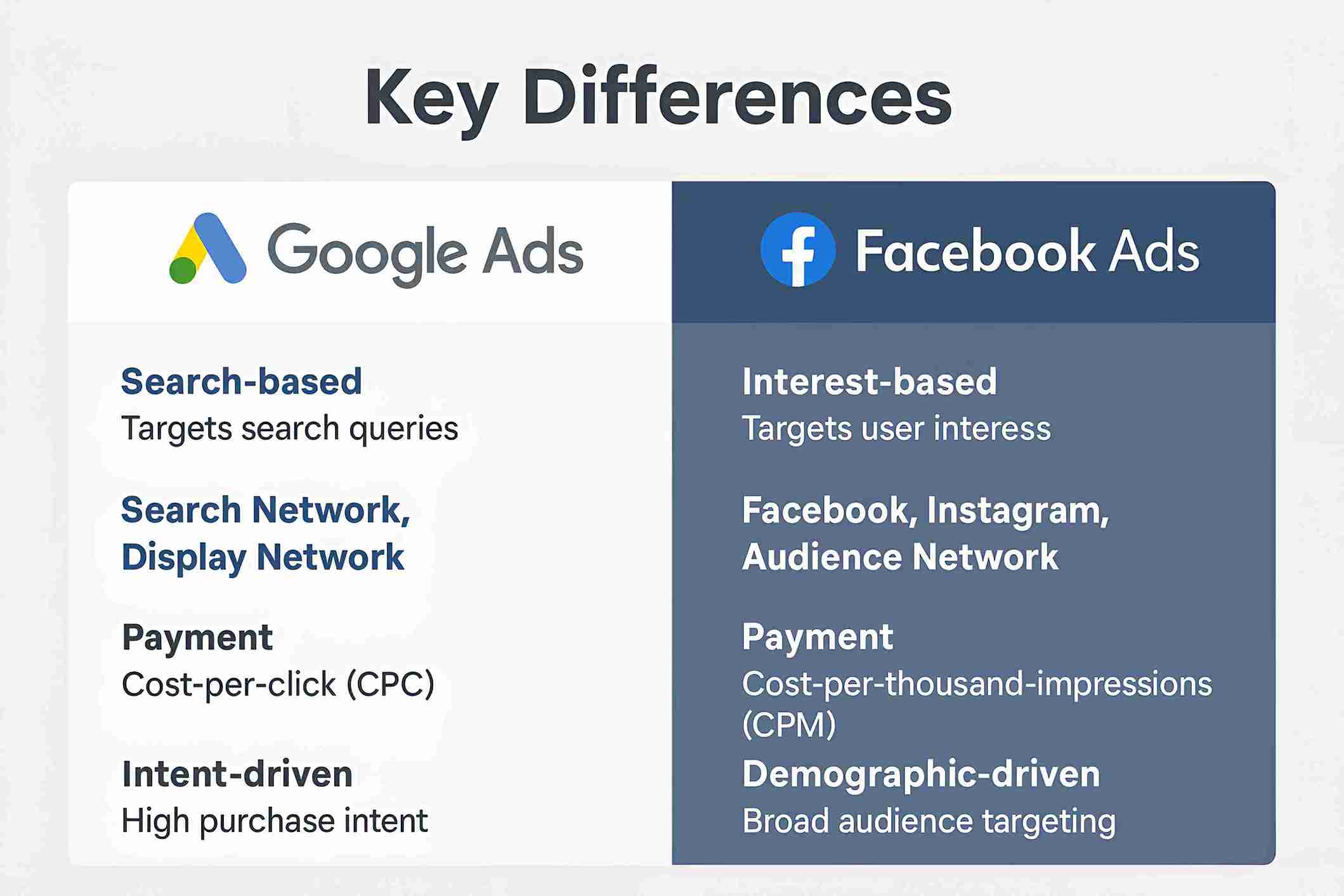
While both platforms are leaders in the digital advertising world, Google Ads and Facebook Ads serve very different purposes. The biggest difference lies in user intent versus audience discovery.
- Google Ads is intent-driven. People actively search for solutions, products, or services, making Google Ads ideal for capturing high-quality leads who are ready to buy.
- Facebook Ads is audience-driven. It introduces your brand to people who may not be actively searching but are likely to be interested based on their demographics, interests, and behaviours.
1. Targeting
- Google Ads: Keywords, demographics, geo-targeting, device, and time of day.
- Facebook Ads: Interests, behaviours, demographics, lookalike audiences, and retargeting.
2. Ad Formats
- Google Ads: Text ads, Shopping ads, Video ads (YouTube), and Display banners.
- Facebook Ads: Carousel ads, video, story ads, collection ads, and dynamic product ads.
3. Audience Behaviour
- Google Ads: Works best for high-intent leads who are ready to purchase.
- Facebook Ads: Ideal for brand discovery, nurturing, and retargeting.
4. Objectives
- Google Ads: Direct conversions, lead generation, immediate sales.
- Facebook Ads: Awareness, engagement, remarketing, and community building.
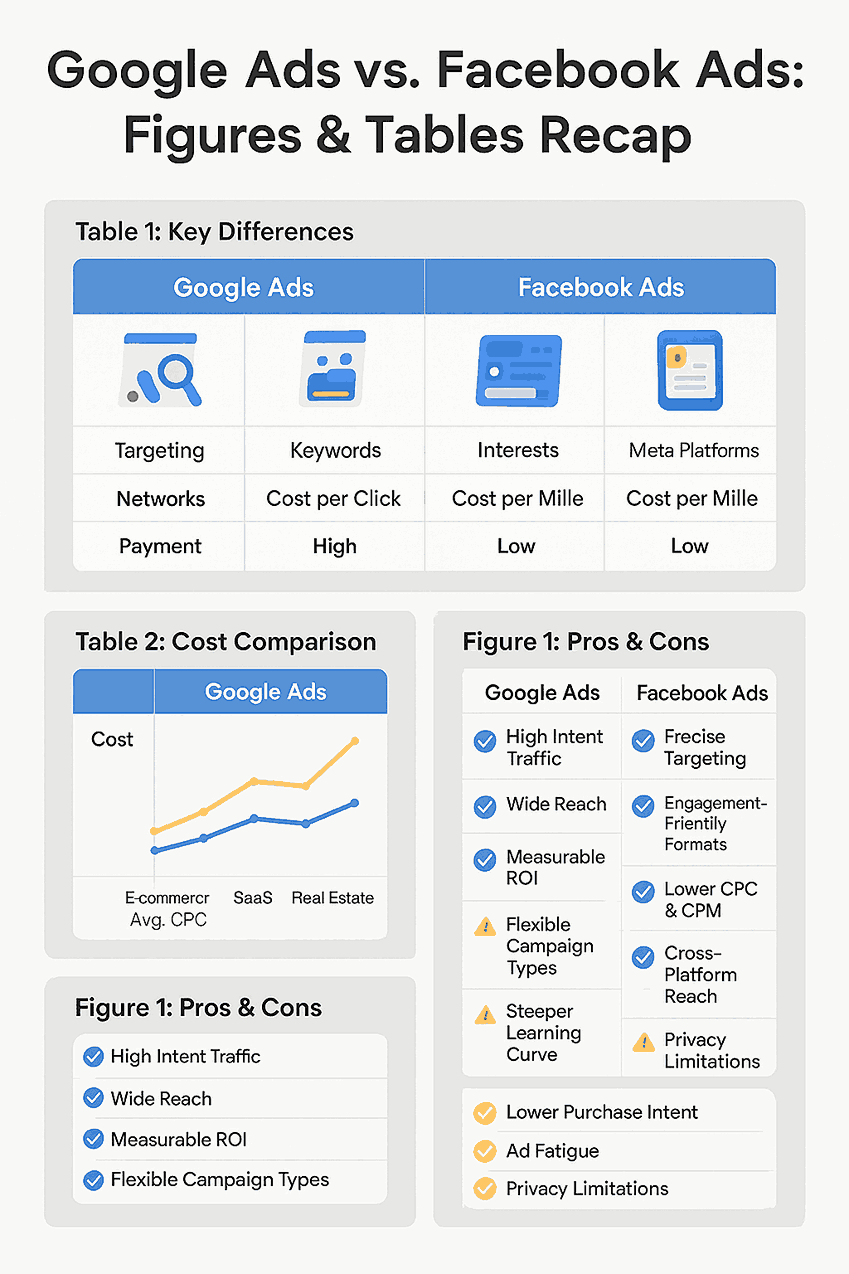
Table 1: Google Ads vs. Facebook Ads
| Feature | Google Ads (Search + Display) | Facebook Ads (Meta Suite) |
| Primary Focus | Capturing intent-driven searches | Audience-based targeting |
| Best Use | Lead generation, direct sales | Awareness, engagement, retargeting |
| Targeting Options | Keywords, demographics, devices, location | Interests, demographics, lookalike audiences |
| Ad Formats | Search text, Display, Shopping, Video | Carousel, Video, Stories, Collection |
| Strengths | High-quality leads, measurable ROI | Creative storytelling, brand-building |
| Weaknesses | Can be expensive in competitive industries | Lower buyer intent, ad fatigue over time |
👉 Want to see which platform has delivered better ROI for real businesses? Check our Case Studies where we compare results across industries.
5. Cost Comparison in 2025
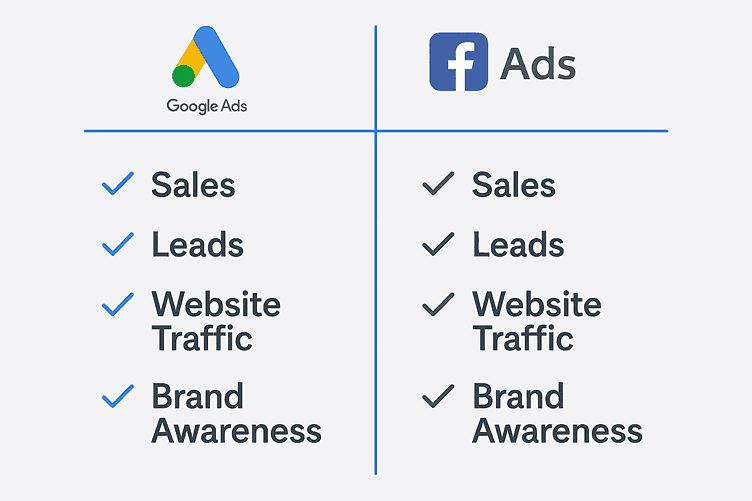
One of the biggest questions businesses ask when comparing Google Ads and Facebook Ads is: Which platform is more cost-effective? The answer depends on your industry, objectives, and audience.
Google Ads Costs
Google Ads generally operates on a Cost-Per-Click (CPC) model. Because it captures users with strong intent, the cost per click can be higher, especially in competitive industries. For example, legal and insurance keywords can reach $20–$45 per click, while e-commerce and local services often average between $1–$5 per click.
Facebook Ads Costs
Facebook Ads are usually priced based on Cost-Per-Thousand Impressions (CPM) or CPC. With Facebook, you’re paying to get in front of audiences rather than targeting active searchers. This often makes the platform more cost-efficient for awareness and engagement campaigns, with average CPCs ranging from $0.50–$2.50, depending on targeting.
Which is Better in 2025?
- Google Ads is ideal if you want high-quality leads and direct conversions, even at a higher cost.
- Facebook Ads is better suited for brand building, retargeting, and lower-cost engagement.
- Many businesses combine both: Google Ads to capture high-intent leads and Facebook Ads to build audiences and retarget them effectively.
Table 2: Cost Comparison by Platform & Industry (2025 Averages)
| Industry | Google Ads Avg. CPC | Facebook Ads Avg. CPC |
| E-commerce | $1.20 – $2.50 | $0.50 – $1.50 |
| Technology / SaaS | $2.00 – $4.00 | $1.00 – $2.50 |
| Real Estate | $1.50 – $3.00 | $0.80 – $2.00 |
| Healthcare | $2.00 – $5.00 | $1.00 – $2.00 |
| Finance / Legal | $15 – $45 | $2.00 – $5.00 |
👉 Want to know where your budget will go further? Request a Google Ads Audit and we’ll help you allocate spend effectively.
6. Pros & Cons of Each Platform:
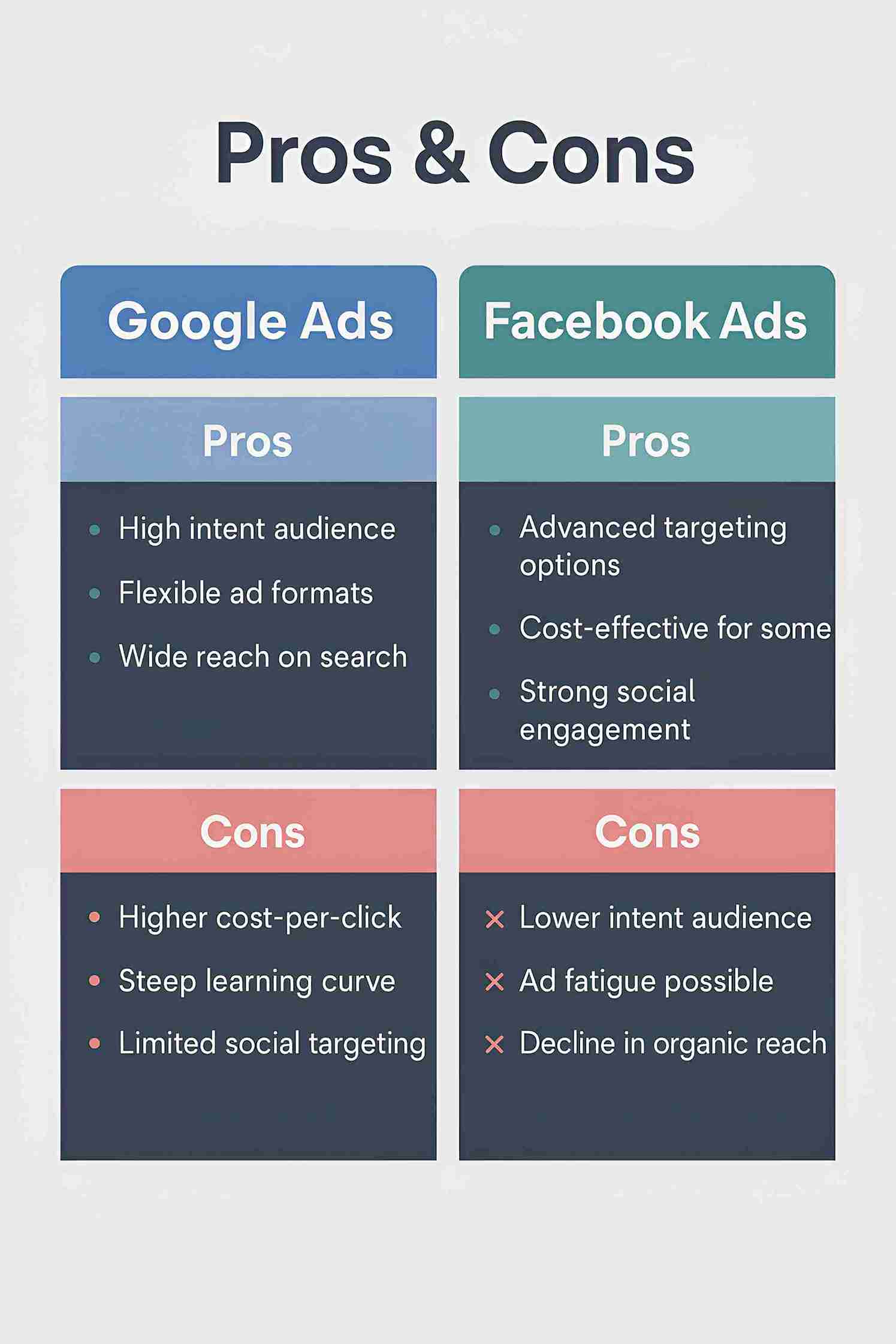
When deciding between Google Ads and Facebook Ads, it’s important to weigh the strengths and weaknesses of each platform. Both can deliver outstanding results—but only if they’re used for the right purpose.
Google Ads – Pros
- High Intent Traffic: Reaches users who are actively searching for your product or service.
- Wide Reach: Ads appear on Google Search, YouTube, Gmail, and partner websites.
- Measurable ROI: Easy to track conversions and calculate return on ad spend (ROAS).
- Flexible Campaign Types: From Search to Performance Max, adaptable to different goals.
Google Ads – Cons
- High CPC in Competitive Industries: Legal, finance, and insurance keywords can be very costly.
- Steeper Learning Curve: Requires careful keyword strategy and campaign management.
Facebook Ads – Pros
- Precise Targeting: Demographics, interests, behaviours, and lookalike audiences.
- Engagement-Friendly Formats: Carousel ads, stories, and videos are great for brand storytelling.
- Lower CPC & CPM: More cost-effective for awareness and engagement campaigns.
- Cross-Platform Reach: Covers both Facebook and Instagram.
Facebook Ads – Cons
- Lower Purchase Intent: Users are not actively searching, which can mean fewer immediate conversions.
- Ad Fatigue: Audiences can tire of seeing the same ad repeatedly.
- Privacy Limitations: iOS updates and privacy rules have reduced tracking accuracy.
Figure 1: Pros & Cons Infographic
(A visual infographic highlighting strengths and weaknesses of both platforms side by side—Google Ads on the left, Facebook Ads on the right.)
👉 Need help choosing the right mix? Our Google Ads Management service ensures you get the most from your advertising budget.
7. Which Platform is Right for Your Business?
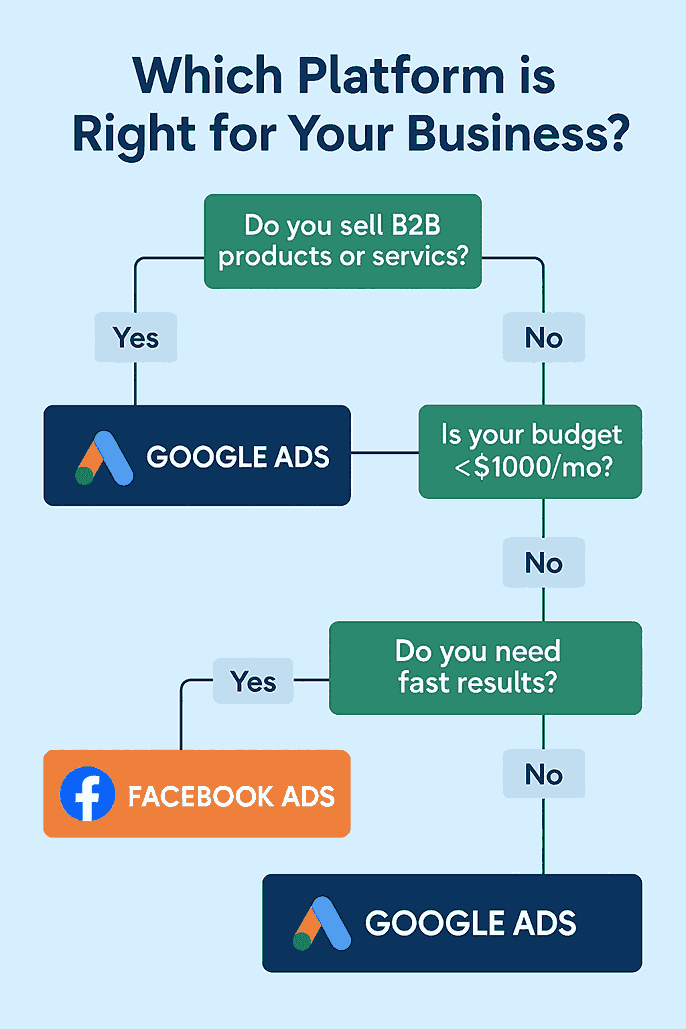
The right platform depends on your business type, goals, and customer journey. Both Google Ads and Facebook Ads offer unique value, but they excel in different areas.
- E-commerce Brands: A combination works best. Use Google Shopping Ads to capture high-intent buyers and Facebook Ads for retargeting and brand awareness.
- Local Services (e.g., plumbers, dentists, salons): Google Ads is typically stronger, as customers are actively searching for immediate solutions.
- SaaS & B2B Companies: Google Ads captures leads from specific keyword searches, while Facebook Ads can help nurture prospects with targeted content.
- Brand-Focused Businesses (fashion, lifestyle, food): Facebook Ads shine by showcasing products visually and building communities.
For most businesses in 2025, the winning approach is a hybrid strategy:
- Use Google Ads to capture high-intent leads ready to convert.
- Use Facebook Ads to create awareness, build loyalty, and retarget potential customers who didn’t convert on the first visit.
👉 Unsure where to start? Our Case Studies show how we’ve helped clients balance both platforms for maximum ROI.
9. Conclusion & Call to Action
- Both Google Ads and Facebook Ads are powerful platforms, but the best choice depends on your business goals. If you want to capture high-intent leads, Google Ads is unmatched. If your focus is awareness, engagement, and retargeting, Facebook Ads offers better value. For many businesses, combining both delivers the strongest results.
- At Google Ads Specialist, we help you build strategies that maximise ROI across platforms. Whether you’re new to advertising or looking to scale, we ensure every dollar works harder.
Our team at Google Ads Specialist ensures campaigns are set up for success, avoiding pitfalls that cost money. Whether you’re a startup or scaling globally, our proven strategies deliver results.