

📑 How Much Does Google Ads Cost in 2025?
1. Introduction
- One of the first questions every business owner asks is: “How much does Google Ads cost in 2025?” The truth is, there’s no single price—it depends on your industry, competition, and targeting. The good news is that Google Ads works on a pay-per-click (PPC) model, meaning you only pay when someone actually clicks your ad. With this flexibility, you can set a daily or monthly budget that fits your needs, whether you’re a small local business or a growing national brand.
- This blog will provide a clear and direct breakdown of Google Ads pricing in 2025. You’ll learn how the PPC auction works, average costs by industry, hidden factors that influence spend, and strategies to control your budget while maximising ROI.
- At Google Ads Specialist, we help businesses spend smarter, not just more. If you’re new here, you can learn more on our About page , explore client Works , or check our full list of Services. You can also browse insights on the Blog , view Resume and Skills , or connect via Contact.
2. Understanding the Google Ads Pricing Model
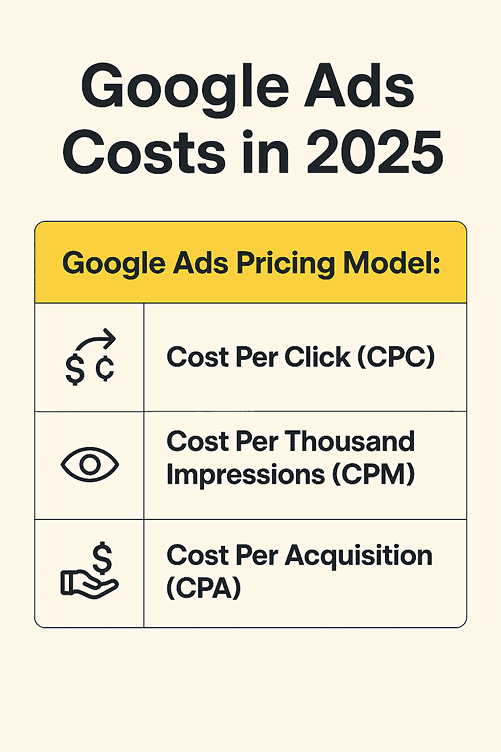
To understand how much Google Ads costs in 2025, you first need to know how the platform’s pricing model works. Google Ads primarily operates on a pay-per-click (PPC) system, where advertisers pay only when someone clicks on their ad. Instead of paying a flat fee, you enter into Google’s auction system, which determines ad placement and cost per click in real time.
Here’s how it works: advertisers bid on keywords relevant to their business. When a user searches for one of those keywords, Google runs an instant auction. The winner is not always the highest bidder—ad quality, relevance, and landing page experience also play a key role. This is measured through Google’s Quality Score, which influences both your ad rank and how much you actually pay.
Several factors affect the final cost:
- Keyword competition: Highly competitive industries like law and insurance see higher CPCs.
- Geographic targeting: Ads in big cities usually cost more than in small towns.
- Device targeting: Mobile vs. desktop bids may differ.
- Ad relevance: A well-optimised ad pays less for the same position.
This means businesses can control costs not just by setting a budget, but by running smarter, higher-quality campaigns.
At Google Ads Specialist, we break down these complexities into simple steps. Our Services are designed to help businesses optimize bidding, improve Quality Scores, and reduce wasted spend. You can also explore detailed campaign results in our Works and read insights on the Blog .
For an official overview, see Google’s Pricing Guide.
3. Average CPC in 2025 by Industry
One of the biggest factors influencing Google Ads cost is your industry. In 2025, average CPC (cost-per-click) continues to vary dramatically depending on how competitive your market is and the lifetime value of a customer.
For example, industries like legal services and insurance remain among the most expensive, with clicks that can reach $20–$45 in highly competitive markets. These sectors can sustain higher CPCs because one client can generate thousands of dollars in revenue, making the higher advertising cost worthwhile.
On the other end, e-commerce campaigns typically see clicks between $1–$3, while many local service providers (such as plumbers, gyms, or salons) usually fall in the $2–$5 range. This makes Google Ads more affordable and accessible for smaller businesses that want to compete with larger brands without overspending.
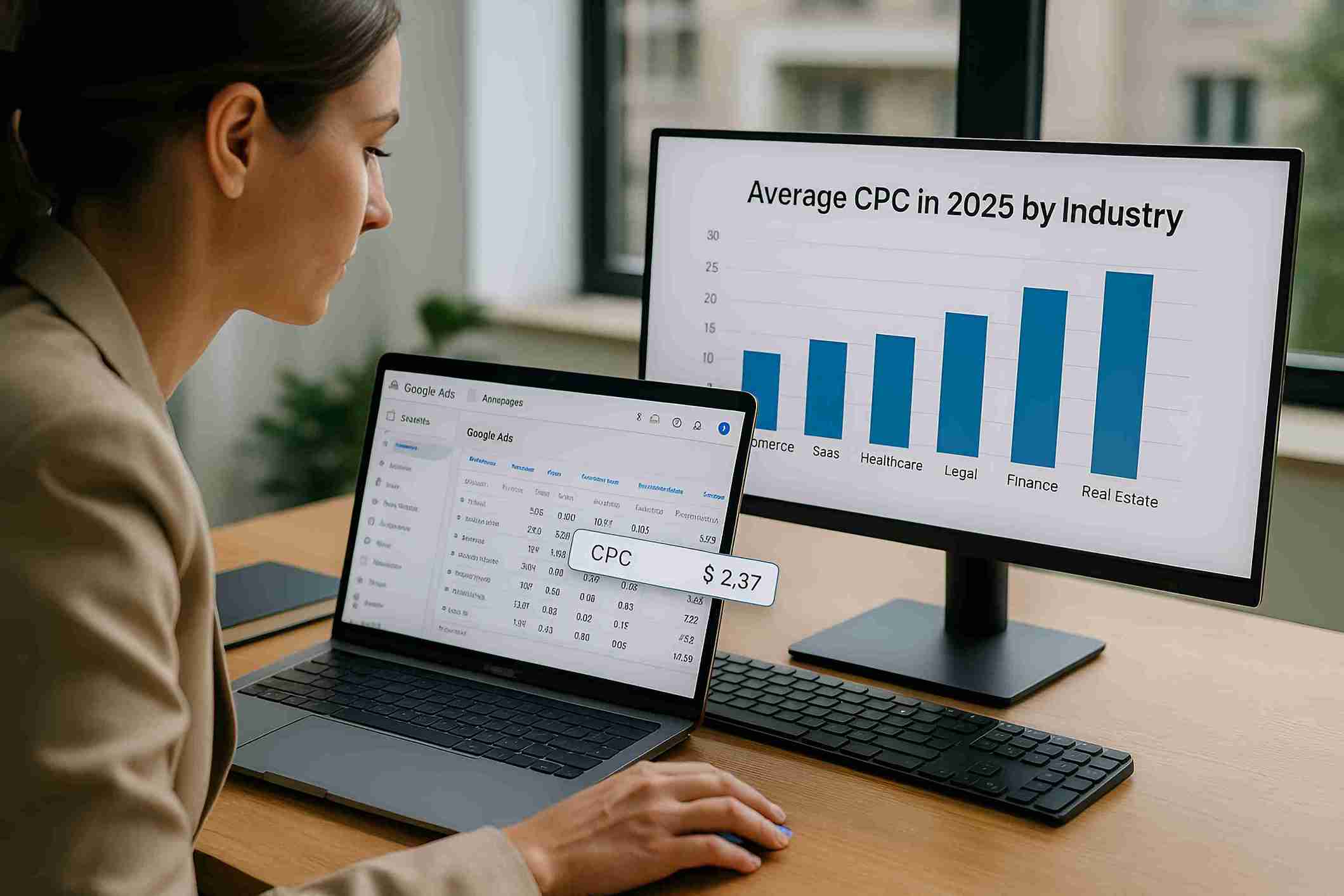
Here’s a clear look at average CPC benchmarks in 2025:
| Industry | Avg. CPC (USD) | Notes |
| Search Ads (all industries avg) | $2.69 | Benchmark across all sectors |
| Display Ads (all industries avg) | $0.63 | Cheaper, used for awareness & remarketing |
| E-commerce (Search) | $1.16 | Lower CPC but competitive with Shopping Ads |
| Technology / SaaS | $2.00 – $4.00 | Still above average due to high-intent B2B searches |
| Real Estate | $1.50 – $3.00 | Affordable in local markets; higher in large metros |
| Healthcare | $2.00 – $5.00 | Demand-driven, moderate CPC range |
| Finance & Insurance | $3.44 | Higher cost due to customer lifetime value |
| Legal Services | $6.75 | Among the highest CPCs in 2025 benchmarks |
- Small businesses in local niches (like salons, gyms, or plumbers) can start with budgets as low as $500–$1,000 per month and see meaningful results.
- Mid-sized companies in SaaS, healthcare, or real estate should expect to spend more per click but balance this with higher-value leads.
- High-value industries (law, finance) need bigger budgets but usually achieve higher returns per client.
The key takeaway is this: CPC is only part of the story. The real measure is cost per acquisition (CPA) and return on ad spend (ROAS). With strong ad quality and targeting, even industries with high CPCs can achieve profitable results.
At Google Ads Specialist, we guide clients through this complexity. Learn how we’ve optimised costs in our Works, explore detailed strategies in our Blog, or request a Google Ads Audit to see where your money can go further.
- Additional Cost Factors Beyond CPC:
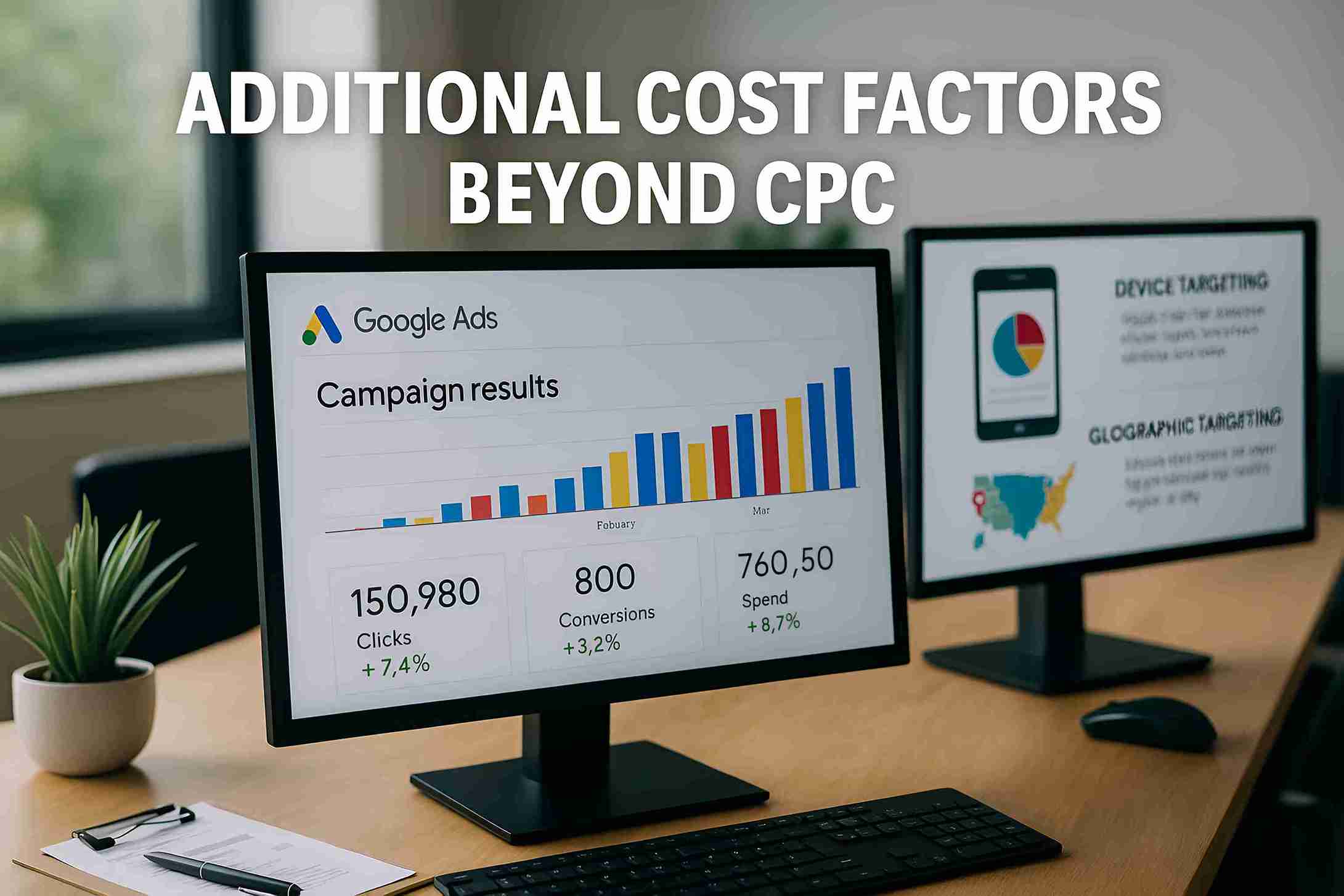
While CPC (cost-per-click) is the most recognised part of Google Ads pricing, it’s not the only factor influencing what you’ll spend in 2025. Several additional elements can significantly impact your campaign costs and overall return.
- Campaign Types
Google Ads isn’t limited to search results. Costs vary depending on the campaign type you choose:
- Search Campaigns: Text ads in search results usually have higher CPC because they target users with strong intent.
- Display Campaigns: Banner ads on partner websites generally cost less per click, but conversion rates can be lower.
- Shopping Ads: Effective for e-commerce, often with competitive CPCs due to product visibility.
- Video Ads (YouTube): Priced differently, often on a cost-per-view (CPV) or CPM basis.
- Device Targeting
Clicks from mobile devices may cost more than desktop, depending on the audience. Businesses with mobile-friendly landing pages tend to see stronger ROI, while those neglecting mobile optimisation risk wasting budget.
- Geography & Location Targeting
Running ads in big cities (New York, London, Paris) costs more than in smaller towns due to higher competition. Local targeting, however, ensures you reach customers more likely to convert, improving efficiency.
- Ad Scheduling
Costs also change based on time of day and day of week. Running ads during peak business hours can mean higher CPC, but often better results. Smart scheduling ensures you don’t burn budget when customers aren’t online.
In short, controlling Google Ads cost goes far beyond keywords. At Google Ads Specialist, we analyse all cost variables for each client. Want to see how these factors play out in real campaigns? Check our Works , explore insights on the Blog, or reach out via Contact for tailored advice.
5. Budget Control Strategies for Beginners
One of the biggest advantages of Google Ads in 2025 is that you are always in control of how much you spend. Beginners often worry about “overspending,” but with the right approach, you can run profitable campaigns on modest budgets.
- Set Daily and Monthly Budgets
Google Ads allows you to define exactly how much you’re willing to spend per day. For new advertisers, starting with $10–$20 daily ensures you can test campaigns without risking large losses. Over time, you can scale based on performance.
- Use Smart Bidding
Google’s automated bidding strategies—like Target CPA (cost per acquisition) or Target ROAS (return on ad spend)—help you bid intelligently. These options use machine learning to optimise for conversions, saving time and money.
- Apply Negative Keywords
Avoid wasted spend by blocking irrelevant searches. For example, if you sell premium products, adding “cheap” or “free” as negative keywords prevents unqualified clicks.
- Test Keyword Match Types
Using Exact Match for precise targeting, and Phrase Match for flexibility, helps beginners avoid the trap of spending too much on broad, irrelevant clicks.
- Monitor and Audit Regularly
Running a monthly audit of your campaigns allows you to identify what’s working and cut what isn’t. Beginners who skip this step often overspend on underperforming ads.
At Google Ads Specialist, we teach businesses how to scale budgets confidently while protecting ROI. To learn how other companies managed costs effectively, explore our Case Studies . For step-by-step expert reviews of your own account, request a Google Ads Audit .
For additional insights, you can also check our Blog for tips tailored to beginners.
6. CPC vs. CPM vs. CPA: Which is Right for You?
While most businesses focus on CPC (cost-per-click), Google Ads also supports other pricing models like CPM (cost-per-thousand impressions) and CPA (cost-per-acquisition). Understanding these options is essential to choosing the right model for your goals in 2025.
- CPC (Cost-per-click): You pay when someone clicks your ad. Best for campaigns focused on driving traffic and leads.
- CPM (Cost-per-thousand impressions): You pay for ad views, regardless of clicks. Ideal for brand awareness and visibility campaigns.
- CPA (Cost-per-acquisition): You pay when a user takes a specific action (purchase, signup, form submission). Excellent for businesses tracking direct ROI.
Each model has unique strengths. A local business may benefit from CPC for lead generation. A new brand might choose CPM to boost awareness quickly. Meanwhile, e-commerce stores often favour CPA, since it directly ties ad spend to conversions.
Table 2: Comparison of CPC, CPM, and CPA
| Model | What You Pay For | Best Suited For | Advantage | Limitation |
| CPC | Clicks | Traffic & leads | Pay only for interest shown | Can be costly in competitive industries |
| CPM | Impressions | Awareness | Wide reach, visual branding | No guarantee of engagement |
| CPA | Conversions | Sales & signups | Direct ROI measurement | Requires strong tracking setup |
At Google Ads Specialist, we help businesses align bidding models with objectives. To see examples, explore our Works and learn more about optimization in our Blog . For professional guidance on choosing the right bidding model, check our Services .
For Google’s official explanation, see Google Ads Pricing Guide .
7. Real-World Examples: Cost Scenarios

- To make Google Ads costs in 2025 more practical, let’s break it down with real-world examples. These scenarios will give you a clear picture of how budgets work across different business types.
- Example 1: Local Plumber
A plumbing company targeting one city might set a budget of $30/day. With an average CPC of $2.50, that equals about 12 clicks daily. If 10–15% of clicks become leads, that’s 1–2 new customers per day—enough to justify the spend, especially for high-value emergency services. - Example 2: E-commerce Store
An online clothing brand may run Shopping Ads with an average CPC of $1.80. A $50/day budget generates roughly 27 clicks. If 2–5% convert at an average order value of $60, that’s $60–$150 revenue per day on $50 spend—still delivering a positive ROI with proper optimisation. - Example 3: SaaS Company
A SaaS startup targeting “CRM software” keywords might face CPCs of $8–$12. With a $100/day budget, they’d expect about 10 clicks. Even if just 1 signup results daily, the long-term recurring revenue potential makes the higher CPC worthwhile. - At Google Ads Specialist, we use data-driven forecasting like this to help clients predict outcomes before spending. For proven results, check our Case Studies , review our Blog , or connect via Contact .
Frequently Asked Questions
Costs vary by industry. Average CPC is about $2.69 for Search, around
$0.63–$1.00 for Display, and higher in competitive sectors like legal or finance.
Yes. Start with $10–$20/day, tighten targeting, use negative keywords, and scale
budgets only when your ROI is proven.
Use CPC to drive traffic/leads, CPM for awareness, and CPA when your conversion
tracking is strong and you want to pay per acquisition.
Absolutely. Set daily/monthly limits, apply Smart Bidding, schedule ads for top
hours, and review Search Terms to cut wasted spend.
8. Figures & Tables Recap
9. Conclusion
Google Ads in 2025 remains one of the most flexible and powerful digital marketing platforms available. While costs vary by industry, competition, and targeting, businesses are always in control of their budgets. Whether you choose CPC, CPM, or CPA, the real key is aligning spend with your goals and consistently optimising campaigns.
By understanding average CPC benchmarks, hidden cost factors, and proven budget strategies, you can avoid overspending and ensure every dollar works toward generating leads or sales. Beginners should start small, monitor results, and scale with confidence.
At Google Ads Specialist, we’ve guided clients across industries to achieve more with less. Want to see proof? Explore our Works . Need expert guidance? Check our Services . Ready to take action? Connect via Contact today.
Our team at Google Ads Specialist ensures campaigns are set up for success, avoiding pitfalls that cost money. Whether you’re a startup or scaling globally, our proven strategies deliver results.
Hire a Google Ads Specialist Today
Frequently Asked Questions
Q. How much does Google Ads cost in 2025?
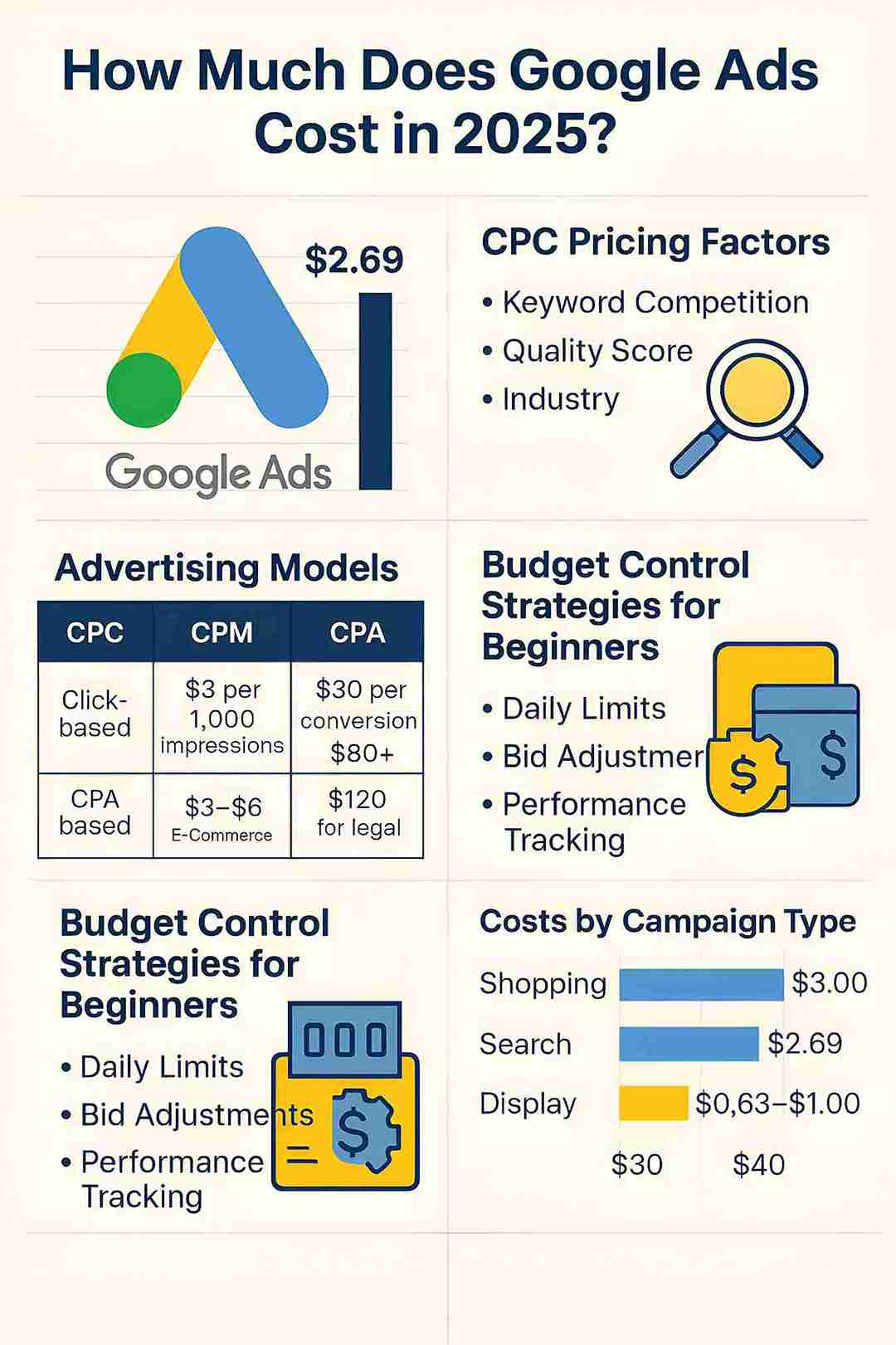
Costs vary by industry. On average, CPC is about $2.69 for search ads, $0.63–$1.00 for display, and $1.50–$3.00 for shopping campaigns. Competitive industries like legal or finance can see CPCs reach $20–$45.
Q. Is Google Ads affordable for small businesses?
Yes. Small businesses can start with daily budgets as low as $10–$20. With smart targeting and optimisation, even modest budgets can generate measurable ROI.
Q. What factors affect Google Ads costs?
The main factors are keyword competition, Quality Score, targeting (location, device, audience), and industry competitiveness. These directly influence CPC.
Q. Which pricing model is best: CPC, CPM, or CPA?
CPC works best for driving clicks and leads, CPM is ideal for brand awareness, and CPA is suitable for businesses focused on direct conversions. The right model depends on your goals.
Q. Can I control my Google Ads budget?
Absolutely. You can set daily or monthly limits, use Smart Bidding, adjust bids, schedule ads, and regularly audit campaigns to stay within your desired spend.
Q. Why are legal and insurance CPCs so high?
Because one client in these industries can generate thousands in revenue, advertisers are willing to bid more, which drives CPCs higher—often $20–$45 per click.
Q. How does Google Ads compare with Facebook Ads in cost?
Google Ads usually has higher CPCs but captures high-intent users actively searching. Facebook Ads may be cheaper but is more focused on audience targeting and awareness.
Costs vary by industry. On average, CPC is about $2.69 for search ads, $0.63–$1.00 for display, and $1.50–$3.00 for shopping campaigns. Competitive industries like legal or finance can see CPCs reach $20–$45.
Yes. Small businesses can start with daily budgets as low as $10–$20. With smart targeting and optimisation, even modest budgets can generate measurable ROI.
The main factors are keyword competition, Quality Score, targeting (location, device, audience), and industry competitiveness. These directly influence CPC.
CPC works best for driving clicks and leads, CPM is ideal for brand awareness, and CPA is suitable for businesses focused on direct conversions. The right model depends on your goals.
Absolutely. You can set daily or monthly limits, use Smart Bidding, adjust bids, schedule ads, and regularly audit campaigns to stay within your desired spend.
Because one client in these industries can generate thousands in revenue, advertisers are willing to bid more, which drives CPCs higher—often $20–$45 per click.
Google Ads usually has higher CPCs but captures high-intent users actively searching. Facebook Ads may be cheaper but is more focused on audience targeting and awareness.