

Why Local Search Matters in 2025
1. Search Volume Trends for “Near Me” Queries
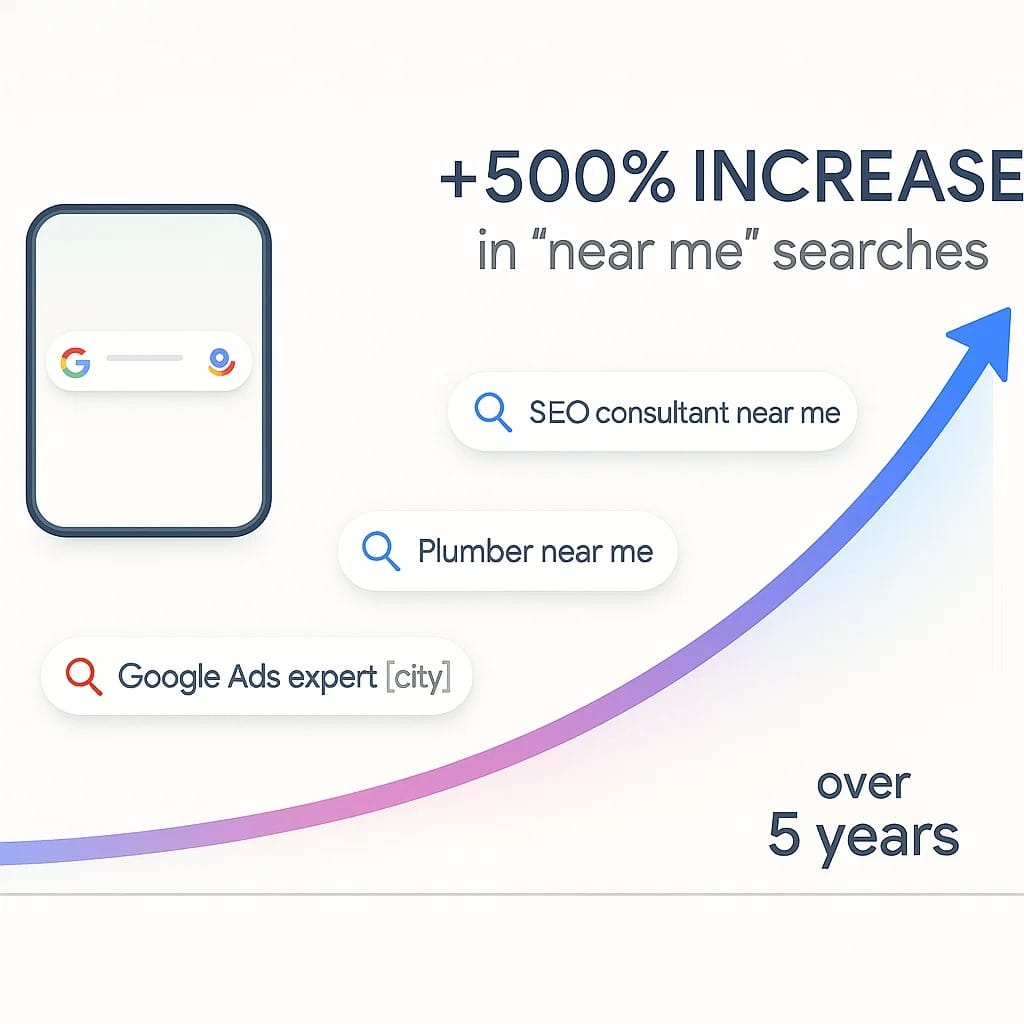
Over 80% of consumers now include phrases like “near me” when searching for services. According to Google’s latest trend data, “near me” searches have increased by over 500% in the past five years. For example:
- “plumber near me”
- “best SEO consultant near me”
“Google Ads expert [city]”
These searches have high intent and conversion rates, especially when backed by precise location targeting.For more guidance on campaign setup, check out my detailed Google Ads campaign optimization guide
2. Mobile-First Consumer Behavior Insights:
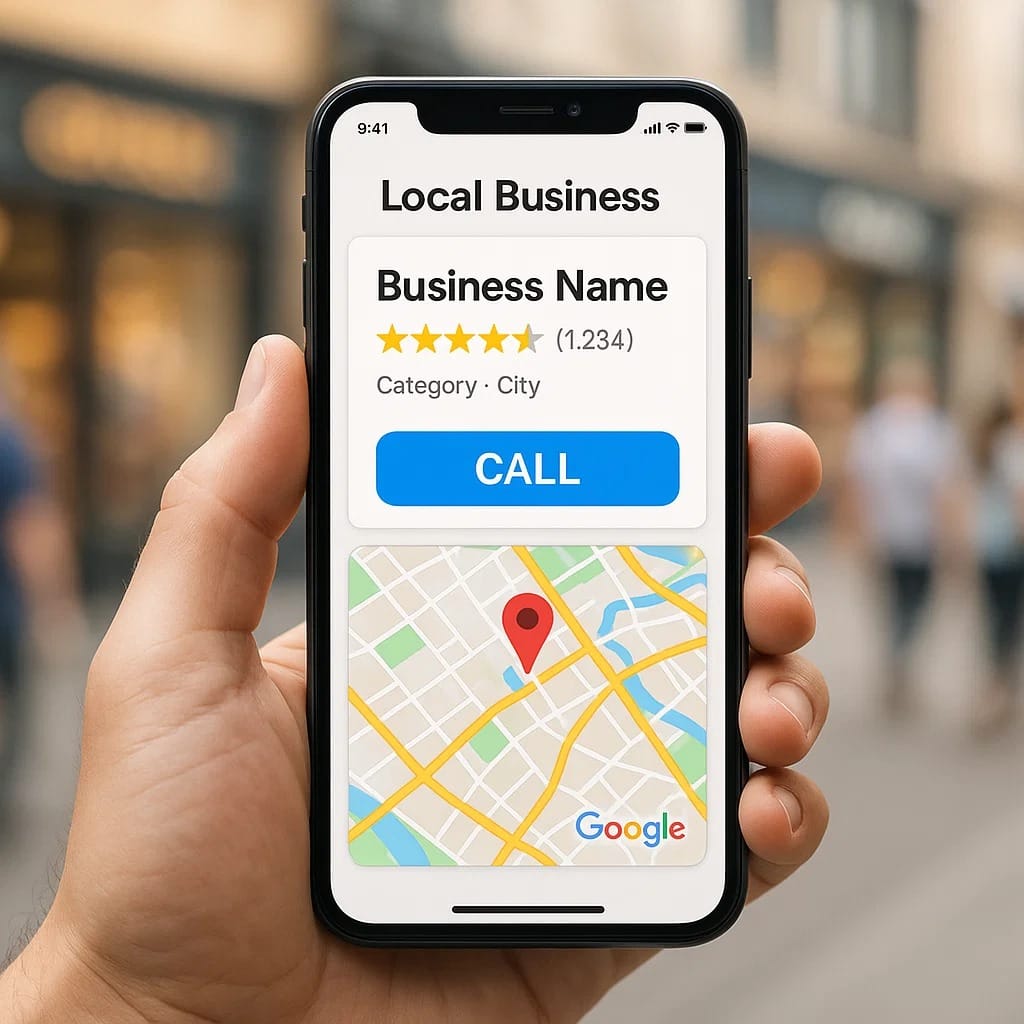
More than 70% of local searches happen on mobile devices. That means your ad strategy needs to be tailored to mobile-first experiences—click-to-call extensions, maps integrations, fast-loading landing pages, and short-form lead gen are crucial. Mobile behavior also shows that users expect immediate results: 60% of mobile users contact a business directly from search results without visiting the website.
Step-by-Step Campaign Setup:
1. Campaign Naming Conventions:
Use a consistent naming structure to manage campaigns at scale. For example:
[Service]-[Location]-[Objective] → GoogleAds-Sydney-LeadGen
This makes it easy to track performance across different geos or services, especially in the reports section.See how I generated 982 HVAC leads with targeted ads in this HVAC lead generation case study
2. Structuring Ad Groups by Theme / Service Area:
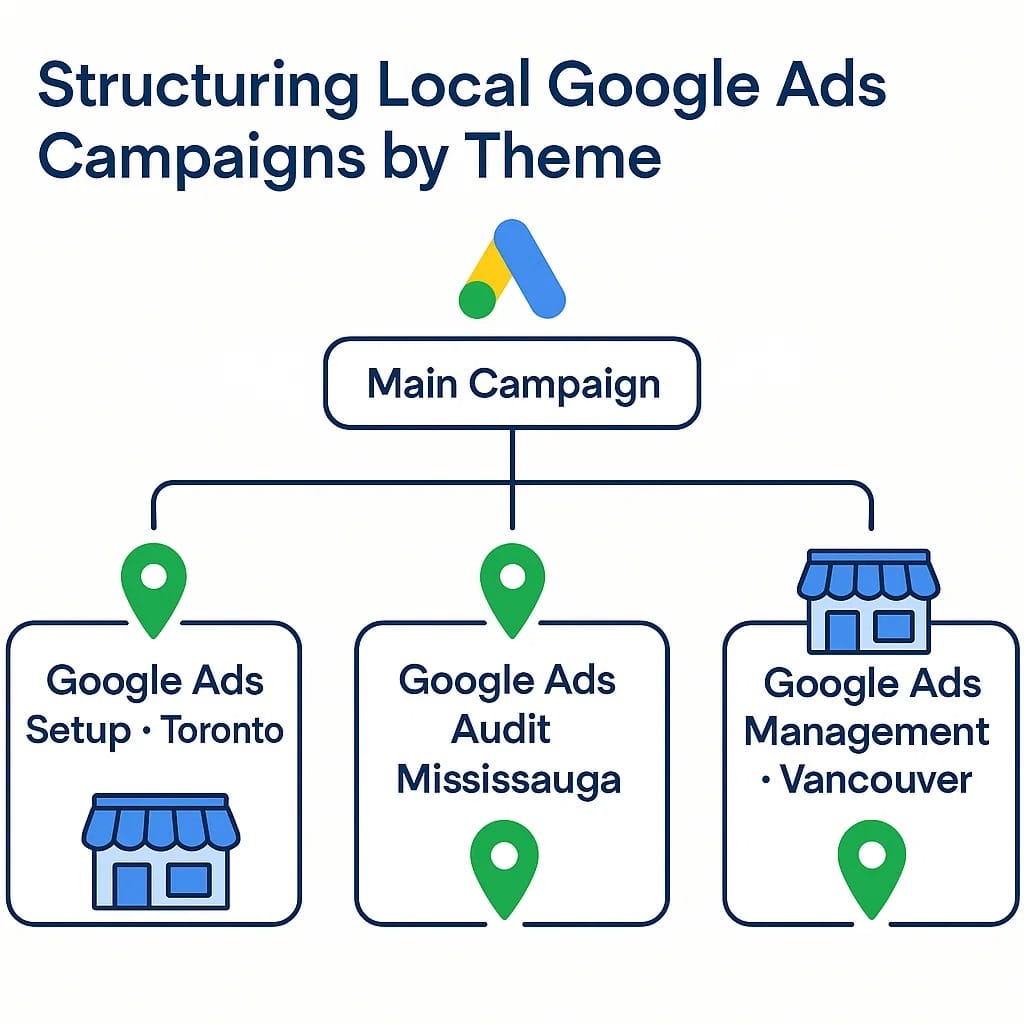
To improve quality score and ad relevance, each ad group should focus on one core service and one specific area.
Example structure for a Google Ads agency:
- Ad Group 1: Google Ads Setup – Toronto
- Ad Group 2: Google Ads Audit – Mississauga
- Ad Group 3: Google Ads Management – Vancouver
Each ad group should include tightly grouped keywords, relevant ad copy, and localized landing pages. This increases CTR, lowers CPC, and raises conversion rates.
2. Keyword Research & Intent Matching
Effective local search campaigns rely on precision targeting—beginning with keyword strategy. A properly researched keyword list ensures your ads reach the right users with the right intent at the right time. Below, we break down the best tools, filtering strategies, and keyword group structures that high-performance advertisers use to dominate local markets.
1. Tools & Filters:
Keyword research for local search must go beyond volume metrics. It should reflect local consumer behavior and intent. Use a combination of the following tools and filters:
- Google Keyword Planner: Start here for search volume trends by city or region. Use the “location” filter to refine results to your target geo.
- Google Trends: Identify seasonal or location-based shifts in local interest.
- Semrush / Ahrefs: Great for uncovering competitor keyword gaps and discovering long-tail, service-based phrases.
- Google Search Console (if already running ads): Analyze existing performance for local variations.
Filtering Tips:
- Focus on keywords with high local intent (e.g., “Google Ads consultant Karachi”)
- Remove broad commercial terms not tied to geography (e.g., “advertising expert”)
- Prioritize keywords with transactional modifiers like “near me,” “hire,” “best,” or “[service] in [city]”
2. Primary vs. Long-Tail vs. Negative Keyword Lists
Primary Keywords
These are high-intent, service-specific keywords used in core ad groups. They typically have higher competition and cost-per-click, but drive strong leads.
Examples:
- “Google Ads management Dubai”
- “local PPC expert in Lahore”
Long-Tail Keywords
Lower search volume, but higher conversion rates. These often include service types, qualifiers, or combinations.
Examples:
- “affordable Google Ads freelancer for dentists”
- “certified Google Ads agency in Islamabad”
Use these to capture highly motivated leads with low CPCs.
Negative Keywords
Prevent wasted spend by excluding irrelevant or low-converting queries.
Common negative keyword types:
- Jobs/careers: “Google Ads jobs”, “freelance hiring”
- Education: “courses”, “how to learn”
- DIY/Searchers: “how to do”, “what is”
Structure Tip:
Maintain a master negative keyword list, but also build ad group-specific exclusions based on actual query reports. This ensures budget efficiency and protects quality score.
5. Ad Structure & Copy That Converts
Crafting compelling ad copy isn’t just creative work—it’s structured persuasion. A winning local PPC ad blends relevance, location-awareness, and clear value to maximize CTR and Quality Score. This section breaks down the key frameworks and copywriting tactics proven to increase conversions in local search.
1. Headline Formula: Proximity + Value
Your headline is the first—and sometimes only—thing a local searcher sees. The most successful headline formulas combine location signals with a specific offer or benefit. Here’s a proven structure:
Formula:
[Service] in [Location] – [Core Benefit or USP]
Examples:
- “Google Ads Expert in Lahore – Free Audit Included”
- “Top-Rated PPC Agency in Dubai – 30% ROI in 30 Days”
- “Local Google Ads Consultant – Results in First Week”
Why It Works:
- Embeds geo-relevance for higher Quality Score
- Triggers location match behavior from users
- Highlights a unique selling proposition (USP) clearly and quickly
Test multiple versions using Responsive Search Ads (RSA) to allow Google to auto-optimize based on user behavior.
2. Description Elements: Offers, Urgency, Trust
Your description should complete the promise made in your headline and drive action. Use this structured framework:
Strong Offer
Lead with a benefit or incentive—this helps differentiate your ad from generic competition.
Example:
- “Book a free 15-minute strategy call with a certified Google Ads expert.”
Urgency Triggers
Add time-sensitive language to nudge immediate clicks.
Examples:
- “Limited slots available this month.”
- “Campaign audit offer ends July 31st.”
Trust Signals
Mention experience, credentials, or proven results.
Examples:
- “10+ years experience, 300+ campaigns managed.”
- “Google Partner Certified | 4.9/5 Client Rating”
Best Practice:
Each description line should support a different conversion lever—benefit, action, and credibility. Avoid fluff or jargon. Ensure your description text closely matches your landing page content to boost Ad Relevance.
6. High‑Impact Ad Extensions for Local Ads
Purpose:
Enhance visibility, increase CTR, and drive local actions like calls, visits, and engagement.
Google Ads extensions are essential for local campaigns. They help convey more value, improve Ad Rank, and give users additional pathways to take action. Below is a table with the most relevant extension types for local search advertisers:
| Extension Type | Purpose | Example |
|---|---|---|
| Location Extension | Show physical address & distance to user | 📍 “Office: 123 Gulberg, Lahore – 2.1 km away” |
| Call Extension | Drive instant calls from mobile devices | 📞 “Call Now: (042) 1234 5678” |
| Sitelink Extension | Link to deep sections (e.g., Services, Pricing) | 👨💼 “Meet the Team” → /about |
| Structured Snippets | Highlight specific service categories | “Services: PPC Management, Landing Pages, CRO” |
| Callout Extension | Add trust-building micro-copy | “24/7 Support · No Setup Fee · Google Certified Partner” |
Extension Best Practices
- Location Extensions
- Link your Google Business Profile (GBP) to your Ads account.
- Improves local CTR by adding proximity info.
- Essential for storefronts or offices serving walk-in customers.
- Call Extensions
- Show click-to-call buttons on mobile searches.
- Track calls as conversions in your dashboard.
- Use during business hours for higher quality leads.
- Sitelinks
- Offer fast navigation to relevant pages like “Pricing,” “Case Studies,” or “Free Audit.”
- Customize by device type—mobile vs. desktop.
- Structured Snippets
- Emphasize service categories or areas of expertise.
- Ideal for agencies or consultants with multiple offerings.
- Callouts
- Short phrases that add credibility or benefit-based language.
- Do not link, but improve ad density and persuasion.
Note: The more extensions you use, the more space your ad takes—and the better your Ad Rank will be, even if your bid is lower than a competitor’s.
7. Landing Page Best Practices
Purpose: Ensure every click leads to a conversion by aligning ad content with user expectations and delivering a seamless, trustworthy experience.
1. Match Ad Message to Landing Page H1
Consistency between your ad copy and landing page headline is non-negotiable. The H1 must reflect the exact value proposition used in the ad headline to create cognitive alignment. For example, if your ad reads “Affordable Google Ads for Local Businesses,” the H1 should mirror this promise:
✅ “Affordable Google Ads Services for Local Growth”
This reinforces user intent, reduces bounce rate, and signals relevance to Google’s quality scoring system. Avoid generic headers like “Welcome to Our Services.”
2. Single CTA Focus
Each landing page should drive one clear conversion goal — whether it’s a form submission, call, or booking. Avoid multiple CTAs like “Learn More,” “Contact Us,” and “Get Quote” on the same page.
Use prominent buttons with action-oriented text:
- “Get Your Free Audit Now”
- “Schedule a Call Today”
- “Book a Strategy Session”
Make the CTA above the fold and repeat it at the bottom of the page.
3. Trust Signals: Testimonials, Certifications, Logos
Trust is a key driver of conversions—especially for local service ads. Include:
- Client Testimonials (with name and photo if possible)
- Google Partner Badge or relevant industry certifications
- Logos of known past clients or partners
Position testimonials midway through the page, just before or after your first CTA. Use star ratings, case study highlights, or a carousel slider for better engagement.
Example:
⭐⭐⭐⭐⭐ “Their local PPC strategy doubled our leads in 3 weeks — highly recommend!” – Imran R., Lahore
- Mobile Optimization Checklist
| Mobile Element | Best Practice |
|---|---|
| Load Speed | Under 3 seconds (use lightweight images & caching) |
| CTA Button Size | Minimum 44x44px tap area |
| Font Legibility | Use 16px+ body font, avoid large blocks of text |
| Sticky CTA | Add floating button for mobile “Tap to Call” |
| Navigation Simplicity | Limit to 3–4 menu items |
| No Pop-Up Intrusion | Avoid full-screen popups that block content |
8. Conversion Tracking: Setup & Validation
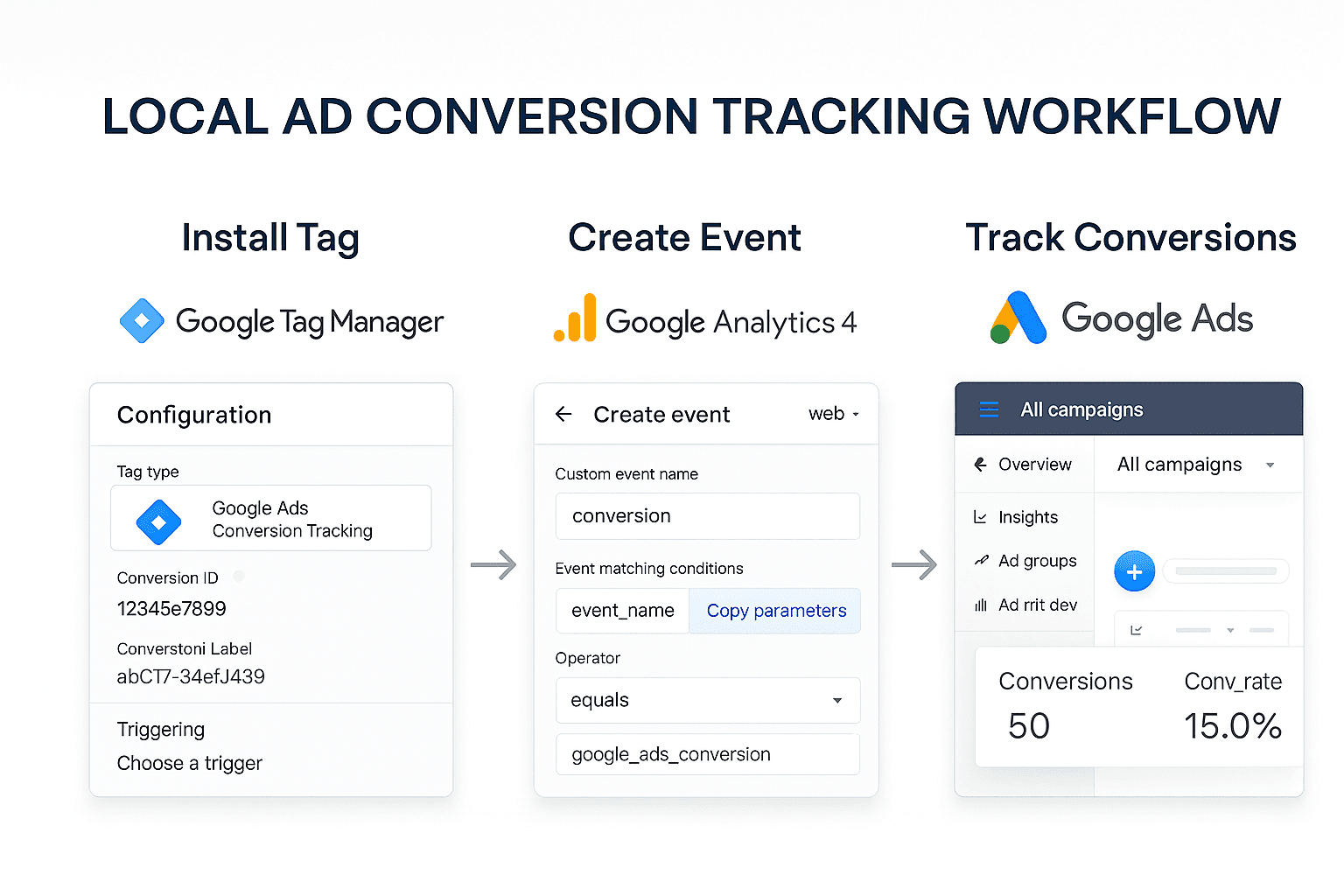
Effective conversion tracking is non-negotiable in local PPC. You can’t improve what you can’t measure. This section outlines precise technical steps for implementing and validating conversions using Google Tag Manager (GTM), Google Analytics 4 (GA4), and Google Ads — plus introduces enhanced conversions for better data fidelity.
2. Example Conversions:
| Conversion Type | Trigger Setup | Platform |
|---|---|---|
| Form Submission | Thank-you page view | GTM + GA4 |
| Phone Click | Click on tel: link | GTM + Google Ads |
| WhatsApp Click | Click on WA link | GA4 Event |
| Email Click | mailto: link click | GTM Trigger |
3. Explanation: Enhanced Conversions
Enhanced Conversions allow you to pass first-party customer data (e.g., email, phone, name) directly to Google Ads in a hashed (secure) format. This improves attribution, especially for offline and cross-device conversions.
How it works:
- Data is collected via the form on your landing page.
- Google securely hashes and matches it to logged-in Google users.
- Attribution accuracy improves, especially in privacy-first environments (e.g., iOS 14+).
✅ Setup Requirements:
- Use Google Tag or GTM with form field mapping (email, name, etc.)
- Ensure consent for data usage per privacy policy
📈 Benefit: Increases match rate and reported ROAS accuracy by up to 15–20%.
9. Ongoing Optimization: Weekly & Monthly Checklist
To drive continuous ROI in local search campaigns, you need to monitor and act on performance insights weekly and monthly. Below is a KPI-based checklist followed by a real-world local campaign example.
✅ Optimization Checklist: KPIs → Actions
| KPI | Recommended Action |
|---|---|
| CTR < 4% | Test new headlines with urgency + proximity modifiers |
| Conversion Rate < 8% | Rework ad copy and CTA; review landing page clarity |
| CPL > Target | Pause low-performing keywords or revise match types |
| Bounce Rate > 60% | Optimize landing page load speed and mobile UX |
| Quality Score < 6 | Improve ad relevance and use tightly themed ad groups |
| Impressions Dropping | Expand geo radius slightly; test new local service keywords |
| Search Impression Share < 70% | Increase bids or budget if within profitable range |
- 📆 Weekly: Focus on ad testing, keyword bids, and budget pacing
- 📆 Monthly: Review Quality Score, location performance, A/B test results
🧪 Real Case Study: Local HVAC Company – Texas
Before Optimization
- CTR: 2.7%
- Conv. Rate: 5.1%
- Cost/Lead: $42
- Bounce Rate: 68%
Actions Implemented
- Introduced urgency in headlines: “24/7 AC Repair Near You”
- Used location extensions and callouts: “Certified Houston Technicians”
- Rebuilt landing pages with single CTA + testimonial section
- Set up enhanced conversion tracking via GTM
- Paused non-converting service keywords
After 30 Days
- CTR: 5.9%
- Conv. Rate: 9.6%
- Cost/Lead: $22
- Bounce Rate: 42%
📌 Key Learnings
- Hyperlocal messaging in ads improves CTR drastically
- CTA clarity and testimonial placement reduce bounce
- Pausing underperformers boosts overall efficiency
- A/B testing headlines weekly leads to continual lift
11. Common Pitfalls & How to Avoid Them
🚫 Top 3 Mistakes Local Advertisers Make
Poor Keyword Intent Targeting
Targeting broad or irrelevant keywords like “marketing” instead of “Google Ads specialist near me.”
Fix: Use local modifiers + long-tail intent-based keywords.
Ignoring Ad Copy Localization
Using generic copy with no city or regional hook.
Fix: Add city/area in headlines + trust signals like “Rated #1 in Lahore.”
Not Tracking Conversions Accurately
No click-to-call or form tracking set up.
Fix: Implement GTM + Enhanced Conversions + test all events.
12. Summary & Next Steps
📌 Key Takeaways
- Keyword intent, copy relevance, and mobile UX drive local campaign ROI.
- Use ad extensions and location-based personalization.
- Track real business outcomes—not just clicks.
📞 What to Do Next
If you’re serious about dominating local search in your area:
- ✅ Book a Free Google Ads Audit with our expert team
- ✅ Or Contact Us for a consultation
Let us help you build high-converting, ROI-positive local campaigns—starting today.